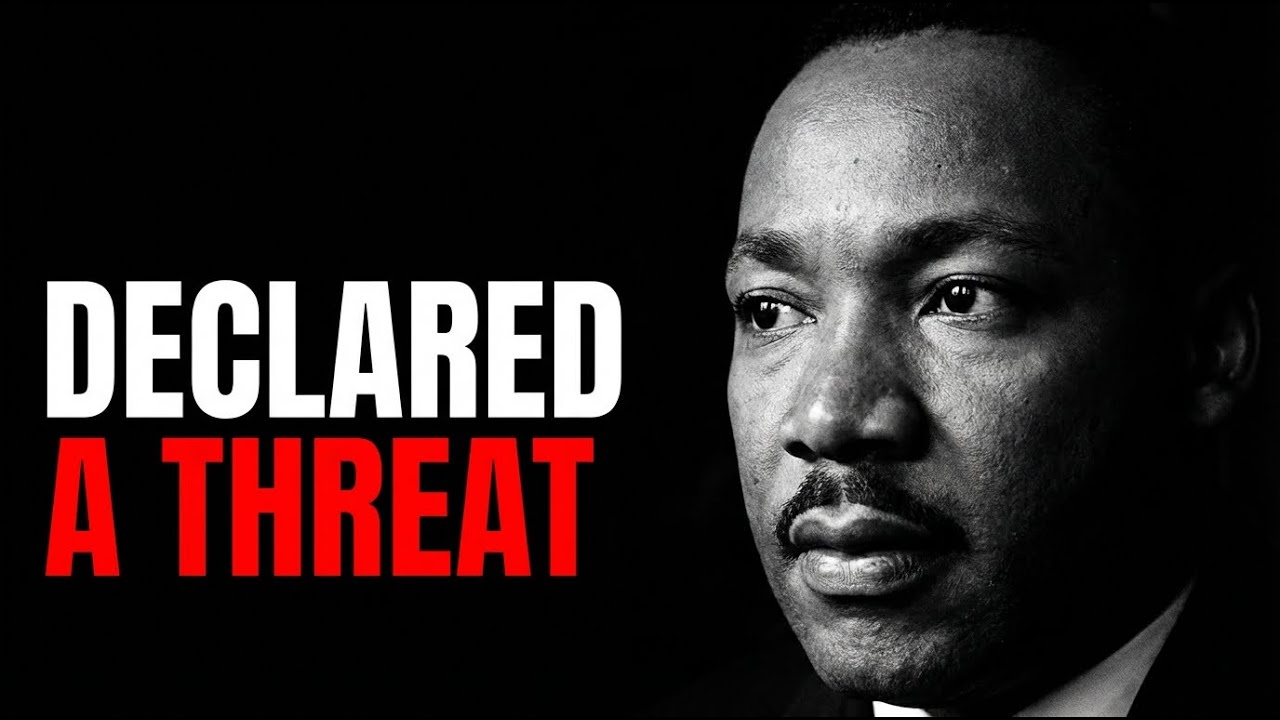
The FBI Sent Martin Luther King Jr. a Letter Telling Him to Kill Himself
In November 1964, Martin Luther King Jr. received a package at his home in Atlanta. Inside was an anonymous letter and a reel of audio tape. The letter, which has since been declassified and is publicly available, told King that the FBI had recorded his extramarital activities and that the recordings would be released to the press. The letter concluded with a passage that historians and FBI officials have consistently interpreted as an instruction to commit suicide: \u201cKing, there is only one thing left for you to do. You know what it is.\u201d
The letter was written by the FBI. Specifically, it was composed by Assistant Director William Sullivan, head of the Bureau's Domestic Intelligence Division, at the direction of J. Edgar Hoover. The operation was part of COINTELPRO's campaign against what the Bureau designated \u201cBlack Nationalist — Hate Groups.\u201d King, a Baptist minister who preached nonviolence, was classified under this heading.
The timing was deliberate. King was scheduled to receive the Nobel Peace Prize on December 10, 1964 — thirty-four days after the letter was mailed. The reference to \u201c34 days\u201d in the letter was a countdown to the ceremony. The FBI intended to either prevent King from accepting the prize or destroy him publicly in the immediate aftermath.
The surveillance that produced the recordings had been authorized by Attorney General Robert Kennedy in October 1963. Wiretaps were placed on King's home, office, and hotel rooms. The FBI's stated justification was King's association with Stanley Levison, an attorney the Bureau alleged had ties to the Communist Party. The actual purpose, documented in internal memos, was to gather material that could be used to discredit King personally.
Hoover's animus toward King was both institutional and personal. A November 1964 press conference saw Hoover publicly call King \u201cthe most notorious liar in the country\u201d — a statement made by the director of the FBI about a Nobel Peace Prize laureate. The suicide letter was mailed shortly after this public attack.
The Bureau's campaign against King extended beyond the letter. FBI agents contacted journalists with derogatory information. The Bureau sent reports to the White House, members of Congress, and foreign intelligence services. Agents attempted to sabotage King's fundraising by contacting donors with negative characterizations. Internal memos describe a coordinated strategy to \u201cdestroy the burrhead\u201d — Hoover's language, preserved in the Bureau's own files.
King received the Nobel Peace Prize on December 10, 1964. He did not publicly acknowledge the letter. He continued to lead the Southern Christian Leadership Conference, organize the Selma-to-Montgomery marches, and expand the movement's focus to economic justice and opposition to the Vietnam War.
The FBI's surveillance continued until King's assassination on April 4, 1968. The Bureau had operatives in Memphis at the time of the shooting. Declassified documents show that military intelligence units were also conducting surveillance of King in Memphis — a fact that was not disclosed to the House Select Committee on Assassinations during its initial investigation.
The suicide letter was declassified in 2014. The full, unredacted text became publicly available through the National Archives. It is typed, unsigned, and designed to appear as if written by a disillusioned Black person within the movement. Its actual author, William Sullivan, later acknowledged the Bureau's campaign against King in testimony before the Church Committee in 1975.
The FBI — the federal law enforcement agency of the United States — sent a letter to a citizen telling him to kill himself. The letter was composed by a senior official, authorized by the director, and timed to coincide with the recipient's receipt of the Nobel Peace Prize. The letter is not speculation. It is not interpretation. It is a declassified document, available to anyone, written on government time, with government resources, by government employees.
They told Martin Luther King Jr. to kill himself. They wrote it down. They mailed it. And then they filed a copy in their own records.
The Surveillance State
The FBI’s interest was not coincidental. Under J. Edgar Hoover’s directorship, the Bureau maintained extensive surveillance programs targeting Black leaders, organizations, and cultural figures who challenged the racial status quo. COINTELPRO — the Counter Intelligence Program — was the formal structure, but the surveillance extended well beyond any single program. Field offices across the country maintained files, cultivated informants, and deployed agents to monitor, disrupt, and discredit individuals the Bureau deemed threatening to domestic order.
The methods were systematic: wiretaps, mail interception, infiltration of organizations, anonymous letters designed to destroy relationships and reputations, and coordination with local law enforcement to harass targets through arrests, tax audits, and public smear campaigns. The goal was not simply intelligence gathering — it was neutralization. The Bureau sought to prevent the rise of what internal memos described as a “Black messiah” who could unify and electrify the masses.
The Broader Struggle
This story did not unfold in isolation. It was part of a vast, interconnected struggle for equality that defined twentieth-century America. From the courtrooms to the streets, from the churches to the legislative chambers, Black Americans and their allies were challenging a system of racial oppression that had been embedded in law, custom, and daily life for centuries. Each individual story — each act of courage, each confrontation with power — was a thread in a larger tapestry of resistance.
What distinguished this era was the systematic nature of both the oppression and the resistance. The movement operated on multiple fronts simultaneously: legal challenges through organizations like the NAACP Legal Defense Fund, economic pressure through boycotts and selective buying campaigns, moral persuasion through nonviolent direct action, and cultural transformation through art, music, and literature that reframed the narrative of Black life in America.
Art as Resistance
Music was never just entertainment in this context — it was a weapon, a shield, and a declaration. Black artists who used their platform to address racial injustice understood that their art reached audiences that political speeches could not. A song could cross racial lines, enter homes through radio waves, and plant ideas in minds that might otherwise remain closed. The government understood this too, which is precisely why artists who spoke out became targets.
The relationship between Black music and political power has always been fraught. Record labels, concert promoters, and radio stations — overwhelmingly white-owned — controlled distribution and access. Artists who pushed too far politically risked losing airplay, bookings, and contracts. The choice between commercial success and authentic expression was rarely simple, and those who chose to speak truth through their art often paid a steep professional and personal price.
Why This Matters Now
This history is not merely an account of past events. It is a living document that shapes the present. The institutions that enabled these abuses — the FBI, local police departments, the courts — continue to operate today. The patterns of surveillance, suppression, and selective justice that defined the treatment of Black Americans in the twentieth century did not end with the passage of civil rights legislation. They evolved, adapted, and persisted in forms that are sometimes more subtle but no less consequential.
Understanding this history is essential not as an exercise in guilt or recrimination, but as a foundation for honest engagement with the ongoing challenges of racial justice in America. The stories of individuals who faced overwhelming institutional power and refused to surrender — who insisted on their dignity, their rights, and their humanity in the face of systematic attempts to deny all three — remain relevant because the struggle they waged is not over.
Leave a Reply