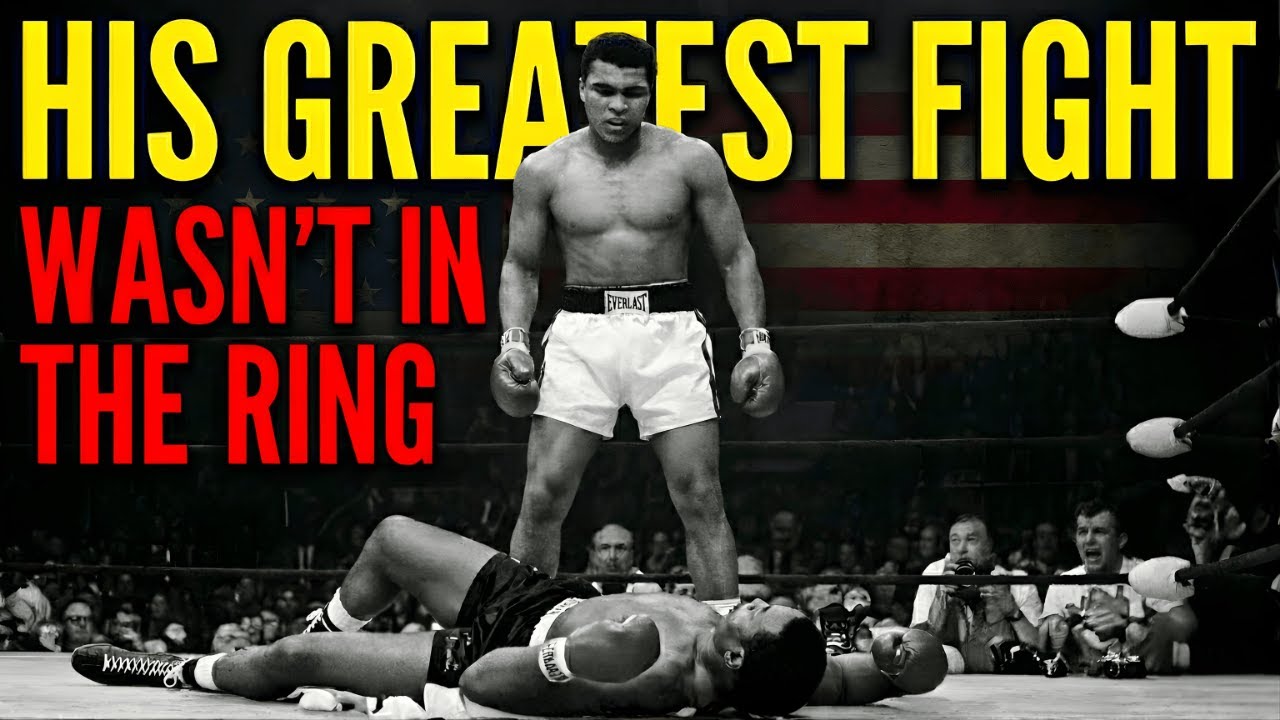
The Government Stripped Muhammad Ali\u2019s Title and Took 3.5 Years of His Career for Refusing to Fight in Vietnam
On April 28, 1967, Muhammad Ali reported to the Armed Forces Examining and Entrance Station in Houston, Texas. When his name was called — Cassius Marcellus Clay — he refused to step forward. He was the heavyweight champion of the world. He was twenty-five years old. He was at the peak of his physical powers. And he refused to be inducted into the United States Army.
Within hours, the New York State Athletic Commission suspended his boxing license. Within days, every other state commission followed. The World Boxing Association stripped his title. He was indicted for draft evasion on May 8, 1967. On June 20, a jury in Houston convicted him. He was sentenced to five years in federal prison and fined $10,000.
The conviction was appealed, and Ali remained free on bail. But the boxing ban was immediate and total. No state in America would license him to fight. His passport was confiscated, preventing international bouts. Muhammad Ali, the most famous athlete on the planet, was unable to practice his profession for three years and seven months.
The financial destruction was calculated. Ali's earning potential during those years — his athletic prime, ages twenty-five through twenty-eight — was estimated in the tens of millions of dollars. He earned nothing from boxing. He supported himself through speaking engagements at college campuses, where he was both celebrated and reviled.
Ali's stated reason was religious: as a minister of the Nation of Islam, he claimed conscientious objector status. The draft board denied the claim. The Department of Justice recommended against it. The hearing officer who reviewed the case recommended granting the exemption, finding Ali's beliefs sincere. The DOJ overruled the hearing officer without explanation.
What the government knew but did not disclose: the FBI had been monitoring Ali since his conversion to the Nation of Islam in 1964. His Bureau file documented his religious practices, his public statements, and his associations. The surveillance was part of the broader COINTELPRO program targeting the Nation of Islam. Ali was not just a draft resister — he was a high-profile member of an organization the FBI was actively trying to destroy.
The case reached the Supreme Court as Clay v. United States. On June 28, 1971, the Court reversed Ali's conviction in an 8-0 decision (Justice Thurgood Marshall recused himself). The ruling was based on a narrow procedural ground: the government had given Ali three reasons for denying his conscientious objector claim, and the Court could not determine which reason the appeal board had relied upon. Since at least one of the reasons was legally erroneous, the conviction could not stand.
Ali returned to boxing in October 1970, before the Supreme Court ruling, when a federal court ordered Georgia to grant him a license. He fought Jerry Quarry in Atlanta. But the three and a half years had taken what they could never return. The Ali who came back was slower, heavier, and more vulnerable than the Ali who had been taken away. He compensated with courage and endurance — the \u201crope-a-dope,\u201d the ability to absorb punishment — but the speed and reflexes of his prime were gone.
Muhammad Ali was diagnosed with Parkinson's syndrome in 1984 at age forty-two. He died on June 3, 2016. He was seventy-four.
The government took three and a half years from the prime of the greatest boxer who ever lived. The Supreme Court said the conviction was wrong. But the years were already gone. You cannot give back a twenty-six-year-old's reflexes to a thirty-year-old. The punishment was the process, and the process was the point.
The Surveillance State
The FBI’s interest was not coincidental. Under J. Edgar Hoover’s directorship, the Bureau maintained extensive surveillance programs targeting Black leaders, organizations, and cultural figures who challenged the racial status quo. COINTELPRO — the Counter Intelligence Program — was the formal structure, but the surveillance extended well beyond any single program. Field offices across the country maintained files, cultivated informants, and deployed agents to monitor, disrupt, and discredit individuals the Bureau deemed threatening to domestic order.
The methods were systematic: wiretaps, mail interception, infiltration of organizations, anonymous letters designed to destroy relationships and reputations, and coordination with local law enforcement to harass targets through arrests, tax audits, and public smear campaigns. The goal was not simply intelligence gathering — it was neutralization. The Bureau sought to prevent the rise of what internal memos described as a “Black messiah” who could unify and electrify the masses.
Justice Deferred
The legal dimensions of this case reveal how the American justice system has historically functioned as both a tool of liberation and a mechanism of oppression. Courts that were capable of landmark civil rights decisions were equally capable of producing outcomes that reinforced racial hierarchies. The same Constitution that guaranteed equal protection under the law was interpreted, for generations, to permit systematic racial discrimination.
What the legal record shows is that justice, when it came at all, came slowly and incompletely. Cases dragged on for years. Evidence was suppressed, witnesses were intimidated, and juries were selected from pools that excluded Black citizens. The system worked exactly as it was designed to work — not to deliver impartial justice, but to maintain the existing social order. When that order was finally challenged, the system resisted with every tool at its disposal.
America’s Pattern of Exile
The forced departure of Black leaders, artists, and intellectuals from the United States represents one of the country’s most damaging patterns of self-inflicted cultural and intellectual loss. Throughout the twentieth century, America systematically drove away some of its most brilliant citizens — not through formal banishment, but through a campaign of harassment, economic pressure, and legal persecution that made remaining in the country untenable.
The list of Black Americans who lived in exile — voluntarily or otherwise — reads like a catalog of American genius. Writers, musicians, scientists, and activists found in Paris, London, Accra, and Havana the freedom to live and work without the constant threat of racial violence and government surveillance. Their departure impoverished American culture while enriching the nations that received them.
Why This Matters Now
This history is not merely an account of past events. It is a living document that shapes the present. The institutions that enabled these abuses — the FBI, local police departments, the courts — continue to operate today. The patterns of surveillance, suppression, and selective justice that defined the treatment of Black Americans in the twentieth century did not end with the passage of civil rights legislation. They evolved, adapted, and persisted in forms that are sometimes more subtle but no less consequential.
Understanding this history is essential not as an exercise in guilt or recrimination, but as a foundation for honest engagement with the ongoing challenges of racial justice in America. The stories of individuals who faced overwhelming institutional power and refused to surrender — who insisted on their dignity, their rights, and their humanity in the face of systematic attempts to deny all three — remain relevant because the struggle they waged is not over.
Leave a Reply