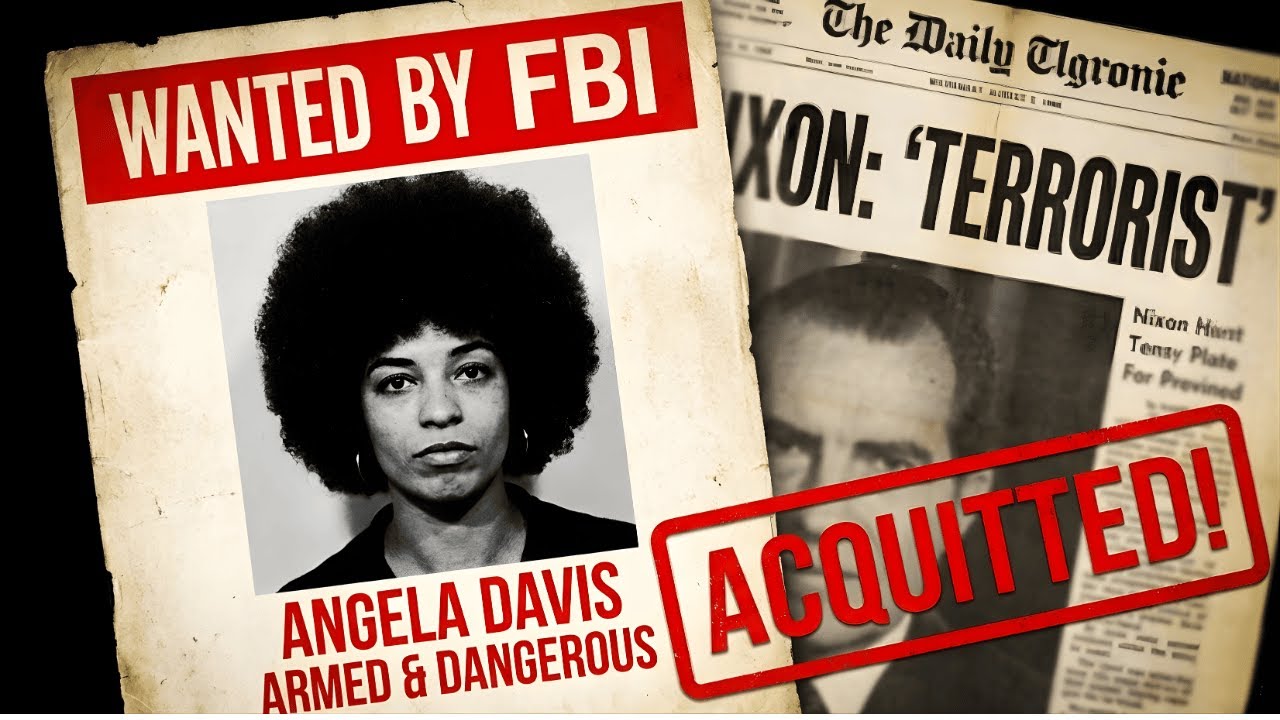
The FBI Put Angela Davis on the Ten Most Wanted List for Guns She Legally Purchased
On August 7, 1970, Jonathan Jackson walked into a Marin County courtroom with four firearms registered to Angela Davis. He armed three San Quentin prisoners during a hostage-taking that ended with four people dead, including Jackson himself and Judge Harold Haley. Davis was not present. She was not involved in the planning. But under California law, the registered owner of firearms used in a crime could be charged as a co-conspirator.
Two days later, J. Edgar Hoover placed Angela Davis on the FBI Ten Most Wanted Fugitives list — the third woman in history to receive the designation. President Richard Nixon publicly congratulated the Bureau. Governor Ronald Reagan had already fired Davis from her teaching position at UCLA in 1969 for being a member of the Communist Party.
Davis was captured in New York City on October 13, 1970. She was extradited to California and held in solitary confinement for sixteen months awaiting trial. The charges: murder, kidnapping, and criminal conspiracy. The prosecution's theory rested on two pillars — that Davis had purchased the guns knowing they would be used in the courthouse assault, and that her personal relationship with George Jackson (Jonathan's brother and a Soledad Brother) proved conspiratorial intent.
The FBI's file on Davis — Bureau File #100-460271 — had been active since 1969, a full year before the Marin County incident. The Bureau monitored her speeches, her classes, her travel, and her associations. COINTELPRO memos from the Los Angeles field office recommended using her Communist Party membership to \u201cneutralize her effectiveness\u201d as a public intellectual.
The trial began on February 28, 1972, in San Jose. Davis acted as co-counsel in her own defense. The prosecution presented no evidence that Davis had foreknowledge of Jonathan Jackson's plan. The gun purchases were legal under California law. The conspiracy charge required proof of an agreement to commit a crime — the prosecution offered inference and association, not documentation.
On June 4, 1972, the jury — all white — returned not guilty verdicts on all three counts. Deliberation took thirteen hours.
The acquittal did not end the surveillance. FBI documents released through FOIA requests show that monitoring of Davis continued through at least 1976. Her file grew to over 1,000 pages. The Bureau tracked her academic career, her political organizing, and her international travel for six years after she was found not guilty of every charge.
The Davis case established a template: use legal gun ownership as the basis for conspiracy charges, attach the defendant's political affiliations as evidence of motive, and prosecute in a jurisdiction chosen for its demographics. The all-white jury rejected it. But the sixteen months of solitary confinement, the Most Wanted designation, and the national spectacle of her arrest accomplished what the verdict could not — it converted a philosophy professor into a permanent target.
Angela Davis was twenty-six years old when the FBI placed her on the Most Wanted list. The guns were legally purchased. The jury said not guilty. The file stayed open.
The Surveillance State
The FBI’s interest was not coincidental. Under J. Edgar Hoover’s directorship, the Bureau maintained extensive surveillance programs targeting Black leaders, organizations, and cultural figures who challenged the racial status quo. COINTELPRO — the Counter Intelligence Program — was the formal structure, but the surveillance extended well beyond any single program. Field offices across the country maintained files, cultivated informants, and deployed agents to monitor, disrupt, and discredit individuals the Bureau deemed threatening to domestic order.
The methods were systematic: wiretaps, mail interception, infiltration of organizations, anonymous letters designed to destroy relationships and reputations, and coordination with local law enforcement to harass targets through arrests, tax audits, and public smear campaigns. The goal was not simply intelligence gathering — it was neutralization. The Bureau sought to prevent the rise of what internal memos described as a “Black messiah” who could unify and electrify the masses.
Justice Deferred
The legal dimensions of this case reveal how the American justice system has historically functioned as both a tool of liberation and a mechanism of oppression. Courts that were capable of landmark civil rights decisions were equally capable of producing outcomes that reinforced racial hierarchies. The same Constitution that guaranteed equal protection under the law was interpreted, for generations, to permit systematic racial discrimination.
What the legal record shows is that justice, when it came at all, came slowly and incompletely. Cases dragged on for years. Evidence was suppressed, witnesses were intimidated, and juries were selected from pools that excluded Black citizens. The system worked exactly as it was designed to work — not to deliver impartial justice, but to maintain the existing social order. When that order was finally challenged, the system resisted with every tool at its disposal.
Why This Matters Now
This history is not merely an account of past events. It is a living document that shapes the present. The institutions that enabled these abuses — the FBI, local police departments, the courts — continue to operate today. The patterns of surveillance, suppression, and selective justice that defined the treatment of Black Americans in the twentieth century did not end with the passage of civil rights legislation. They evolved, adapted, and persisted in forms that are sometimes more subtle but no less consequential.
Understanding this history is essential not as an exercise in guilt or recrimination, but as a foundation for honest engagement with the ongoing challenges of racial justice in America. The stories of individuals who faced overwhelming institutional power and refused to surrender — who insisted on their dignity, their rights, and their humanity in the face of systematic attempts to deny all three — remain relevant because the struggle they waged is not over.
Leave a Reply