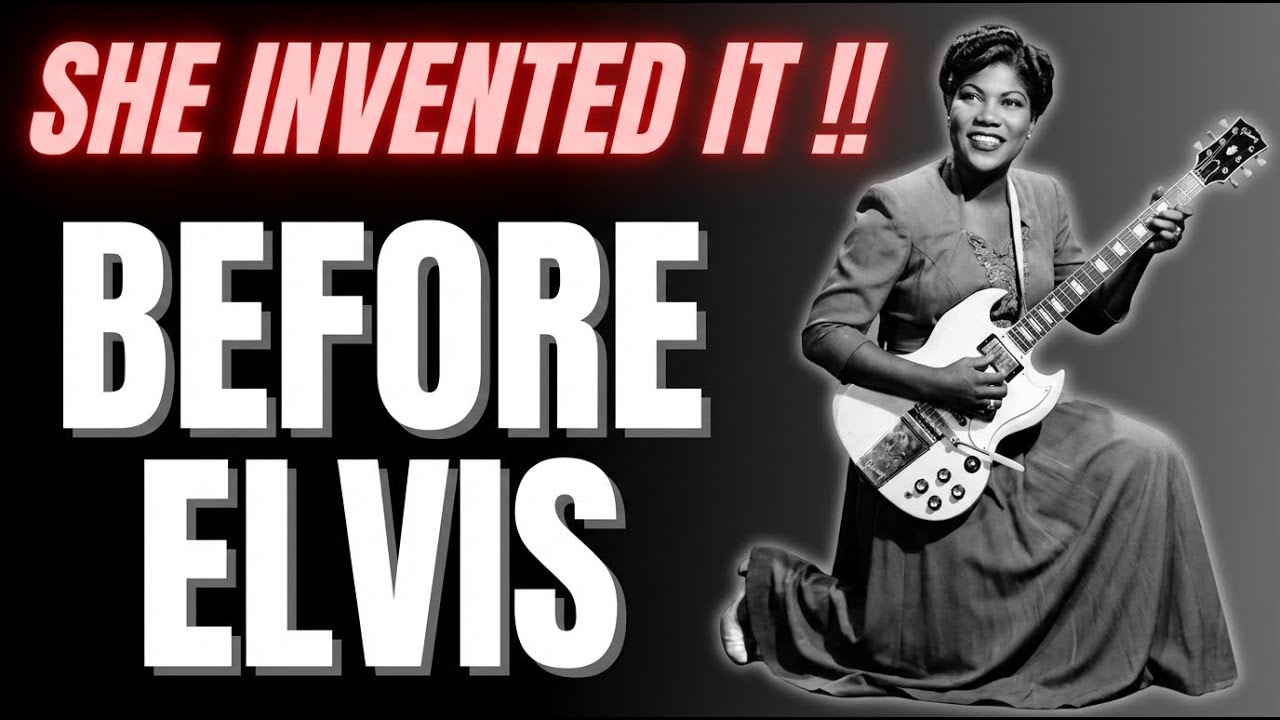
They Stole Rock and Roll From a Black Woman
Rock and roll did not begin with Elvis Presley. It began with Sister Rosetta Tharpe.
Decades before rock became a commercial genre, Tharpe fused gospel, blues, and electric guitar into a sound that defined everything that followed. In the late 1930s and early 1940s, during Jim Crow segregation, she was playing distorted electric guitar, crossing sacred and secular music, and recording songs that many historians now recognize as the first true rock and roll records.
Tharpe was born in Cotton Plant, Arkansas, and grew up performing in Holiness churches where music was physical, ecstatic, and unrestrained. By 1938, she had signed with Decca Records and was performing at Carnegie Hall and the Cotton Club. She played electric guitar with a ferocity and showmanship that no one in popular music had seen. Her 1944 recording of "Strange Things Happening Every Day" crossed onto the national pop charts, years before rock had a name or a category.
Chuck Berry called her his favorite guitarist. Little Richard said she was the reason he learned to play. Johnny Cash cited her as a direct influence. Keith Richards said hearing her was the moment he wanted to pick up a guitar. Yet when the story of rock and roll was written for mainstream audiences, Tharpe was left out entirely. The genre she invented was credited to the white artists who came after her.
The erasure was not accidental. During the 1950s, the music industry deliberately marketed rock and roll through white performers to reach white audiences. Alan Freed, the disc jockey often credited with popularizing the term "rock and roll," built his career on music Black artists had been making for years. Elvis recorded songs originally performed by Black musicians and was presented as an innovator rather than an interpreter.
Sister Rosetta Tharpe was finally inducted into the Rock and Roll Hall of Fame in 2018, more than seventy years after she recorded the music that started it all. She had been dead for forty-five years. The Hall's own delay is part of the evidence.
The Surveillance State
The FBI’s interest was not coincidental. Under J. Edgar Hoover’s directorship, the Bureau maintained extensive surveillance programs targeting Black leaders, organizations, and cultural figures who challenged the racial status quo. COINTELPRO — the Counter Intelligence Program — was the formal structure, but the surveillance extended well beyond any single program. Field offices across the country maintained files, cultivated informants, and deployed agents to monitor, disrupt, and discredit individuals the Bureau deemed threatening to domestic order.
The methods were systematic: wiretaps, mail interception, infiltration of organizations, anonymous letters designed to destroy relationships and reputations, and coordination with local law enforcement to harass targets through arrests, tax audits, and public smear campaigns. The goal was not simply intelligence gathering — it was neutralization. The Bureau sought to prevent the rise of what internal memos described as a “Black messiah” who could unify and electrify the masses.
The Broader Struggle
This story did not unfold in isolation. It was part of a vast, interconnected struggle for equality that defined twentieth-century America. From the courtrooms to the streets, from the churches to the legislative chambers, Black Americans and their allies were challenging a system of racial oppression that had been embedded in law, custom, and daily life for centuries. Each individual story — each act of courage, each confrontation with power — was a thread in a larger tapestry of resistance.
What distinguished this era was the systematic nature of both the oppression and the resistance. The movement operated on multiple fronts simultaneously: legal challenges through organizations like the NAACP Legal Defense Fund, economic pressure through boycotts and selective buying campaigns, moral persuasion through nonviolent direct action, and cultural transformation through art, music, and literature that reframed the narrative of Black life in America.
Art as Resistance
Music was never just entertainment in this context — it was a weapon, a shield, and a declaration. Black artists who used their platform to address racial injustice understood that their art reached audiences that political speeches could not. A song could cross racial lines, enter homes through radio waves, and plant ideas in minds that might otherwise remain closed. The government understood this too, which is precisely why artists who spoke out became targets.
The relationship between Black music and political power has always been fraught. Record labels, concert promoters, and radio stations — overwhelmingly white-owned — controlled distribution and access. Artists who pushed too far politically risked losing airplay, bookings, and contracts. The choice between commercial success and authentic expression was rarely simple, and those who chose to speak truth through their art often paid a steep professional and personal price.
Why This Matters Now
This history is not merely an account of past events. It is a living document that shapes the present. The institutions that enabled these abuses — the FBI, local police departments, the courts — continue to operate today. The patterns of surveillance, suppression, and selective justice that defined the treatment of Black Americans in the twentieth century did not end with the passage of civil rights legislation. They evolved, adapted, and persisted in forms that are sometimes more subtle but no less consequential.
Understanding this history is essential not as an exercise in guilt or recrimination, but as a foundation for honest engagement with the ongoing challenges of racial justice in America. The stories of individuals who faced overwhelming institutional power and refused to surrender — who insisted on their dignity, their rights, and their humanity in the face of systematic attempts to deny all three — remain relevant because the struggle they waged is not over.
Leave a Reply