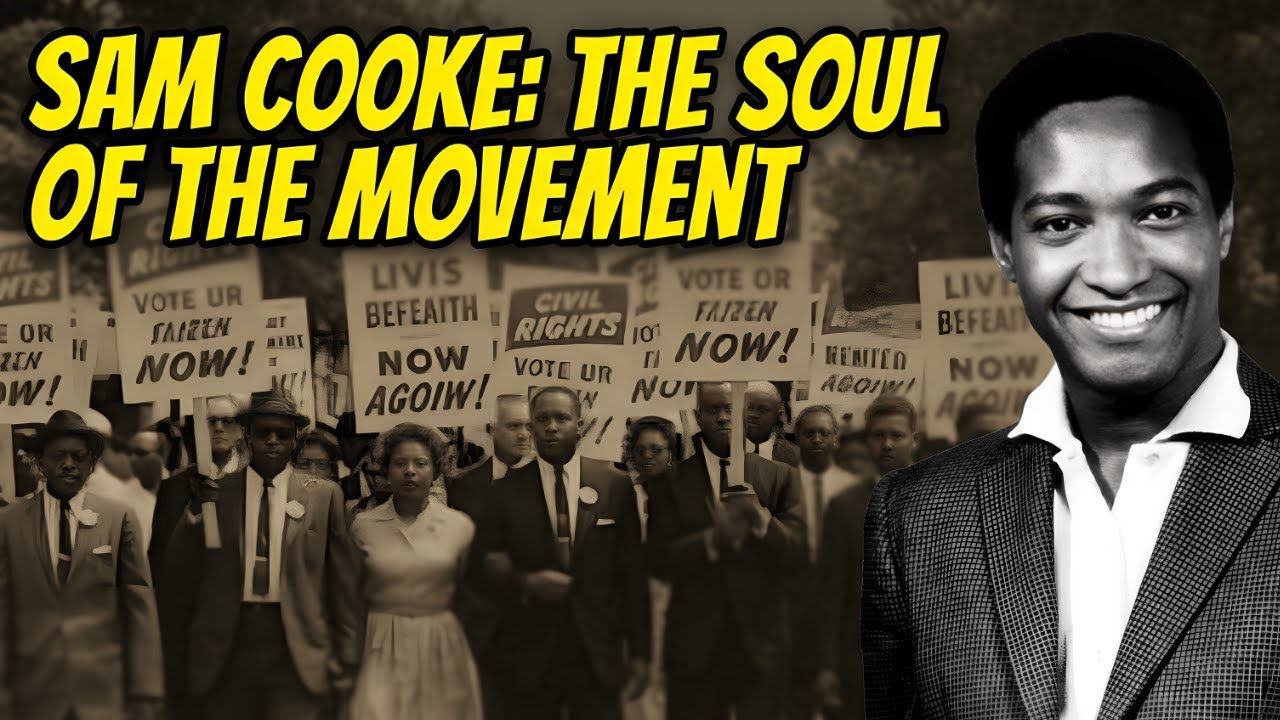
Sam Cooke Built a Black-Owned Music Empire. He Died Under Circumstances That Have Never Been Explained.
Sam Cooke was not just the greatest soul singer of his generation. He was the first Black artist to own his own record label, his own publishing company, and his own masters. By 1964, he had built SAR Records, Tracey Publishing, and Kags Music — a vertically integrated business structure that gave him control over every revenue stream in the music industry. No Black artist had achieved this before.
On December 11, 1964, Sam Cooke was shot and killed at the Hacienda Motel in Los Angeles. He was thirty-three years old. The official account: Cooke brought a woman named Elisa Boyer to the motel; Boyer fled with his clothes; Cooke, in a rage, confronted the motel manager, Bertha Franklin, who shot him in self-defense with a .22 caliber pistol. The shooting was ruled justifiable homicide. The investigation was closed within two weeks.
The circumstances remain, six decades later, deeply suspicious.
Boyer's account contained inconsistencies that were never resolved. She claimed Cooke had forced her to the motel, but witnesses at the bar where they met reported that Boyer approached Cooke, not the reverse. Boyer had a criminal record including charges of prostitution and writing bad checks — facts that were not explored in the investigation. She later sued Cooke's estate.
Franklin's account also raised questions. She testified that Cooke broke down the office door and attacked her, and that she shot him in self-defense. The physical evidence showed Cooke had been beaten severely — far beyond what a single encounter with a motel manager would produce. His injuries included contusions inconsistent with a single struggle.
The LAPD investigation was remarkably brief for a case involving one of the most famous musicians in America. No independent forensic analysis was conducted. The crime scene was not preserved. The inquest lasted one day.
What makes Cooke's death significant beyond the tragedy is what he was building. SAR Records had signed Bobby Womack, the Valentinos, Johnnie Taylor, and other artists. Tracey Publishing controlled the copyrights to songs that would generate millions in revenue for decades. Kags Music handled administration. Cooke was constructing the infrastructure that Berry Gordy had built with Motown — but with one critical difference: Cooke owned it himself, not as a corporate entity that could be sold or diluted.
After Cooke's death, his business empire was dismantled. Allen Klein, Cooke's manager, gained control of his catalog and business interests. The publishing rights that Cooke had fought to own passed out of his family's control. The economic architecture he had built was absorbed into the existing industry structure.
Cooke had also become increasingly political in the months before his death. \u201cA Change Is Gonna Come,\u201d released posthumously in December 1964, was his most explicitly political song — a direct response to Bob Dylan's \u201cBlowin' in the Wind,\u201d which Cooke heard and said: \u201cA white boy writing a song like that?\u201d He wrote his answer. He did not live to see it become a civil rights anthem.
Sam Cooke\u2019s death was ruled justifiable homicide after a two-week investigation. The man who owned his masters, owned his publishing, owned his label, and was building a model for Black economic independence in the music industry was shot in a motel and the case was closed before the month ended.
The LAPD file has never been reopened. The questions have never been answered. And the empire Sam Cooke built was taken apart before his body was cold.
The Surveillance State
The FBI’s interest was not coincidental. Under J. Edgar Hoover’s directorship, the Bureau maintained extensive surveillance programs targeting Black leaders, organizations, and cultural figures who challenged the racial status quo. COINTELPRO — the Counter Intelligence Program — was the formal structure, but the surveillance extended well beyond any single program. Field offices across the country maintained files, cultivated informants, and deployed agents to monitor, disrupt, and discredit individuals the Bureau deemed threatening to domestic order.
The methods were systematic: wiretaps, mail interception, infiltration of organizations, anonymous letters designed to destroy relationships and reputations, and coordination with local law enforcement to harass targets through arrests, tax audits, and public smear campaigns. The goal was not simply intelligence gathering — it was neutralization. The Bureau sought to prevent the rise of what internal memos described as a “Black messiah” who could unify and electrify the masses.
The Broader Struggle
This story did not unfold in isolation. It was part of a vast, interconnected struggle for equality that defined twentieth-century America. From the courtrooms to the streets, from the churches to the legislative chambers, Black Americans and their allies were challenging a system of racial oppression that had been embedded in law, custom, and daily life for centuries. Each individual story — each act of courage, each confrontation with power — was a thread in a larger tapestry of resistance.
What distinguished this era was the systematic nature of both the oppression and the resistance. The movement operated on multiple fronts simultaneously: legal challenges through organizations like the NAACP Legal Defense Fund, economic pressure through boycotts and selective buying campaigns, moral persuasion through nonviolent direct action, and cultural transformation through art, music, and literature that reframed the narrative of Black life in America.
Art as Resistance
Music was never just entertainment in this context — it was a weapon, a shield, and a declaration. Black artists who used their platform to address racial injustice understood that their art reached audiences that political speeches could not. A song could cross racial lines, enter homes through radio waves, and plant ideas in minds that might otherwise remain closed. The government understood this too, which is precisely why artists who spoke out became targets.
The relationship between Black music and political power has always been fraught. Record labels, concert promoters, and radio stations — overwhelmingly white-owned — controlled distribution and access. Artists who pushed too far politically risked losing airplay, bookings, and contracts. The choice between commercial success and authentic expression was rarely simple, and those who chose to speak truth through their art often paid a steep professional and personal price.
America’s Pattern of Exile
The forced departure of Black leaders, artists, and intellectuals from the United States represents one of the country’s most damaging patterns of self-inflicted cultural and intellectual loss. Throughout the twentieth century, America systematically drove away some of its most brilliant citizens — not through formal banishment, but through a campaign of harassment, economic pressure, and legal persecution that made remaining in the country untenable.
The list of Black Americans who lived in exile — voluntarily or otherwise — reads like a catalog of American genius. Writers, musicians, scientists, and activists found in Paris, London, Accra, and Havana the freedom to live and work without the constant threat of racial violence and government surveillance. Their departure impoverished American culture while enriching the nations that received them.
Why This Matters Now
This history is not merely an account of past events. It is a living document that shapes the present. The institutions that enabled these abuses — the FBI, local police departments, the courts — continue to operate today. The patterns of surveillance, suppression, and selective justice that defined the treatment of Black Americans in the twentieth century did not end with the passage of civil rights legislation. They evolved, adapted, and persisted in forms that are sometimes more subtle but no less consequential.
Understanding this history is essential not as an exercise in guilt or recrimination, but as a foundation for honest engagement with the ongoing challenges of racial justice in America. The stories of individuals who faced overwhelming institutional power and refused to surrender — who insisted on their dignity, their rights, and their humanity in the face of systematic attempts to deny all three — remain relevant because the struggle they waged is not over.
Leave a Reply