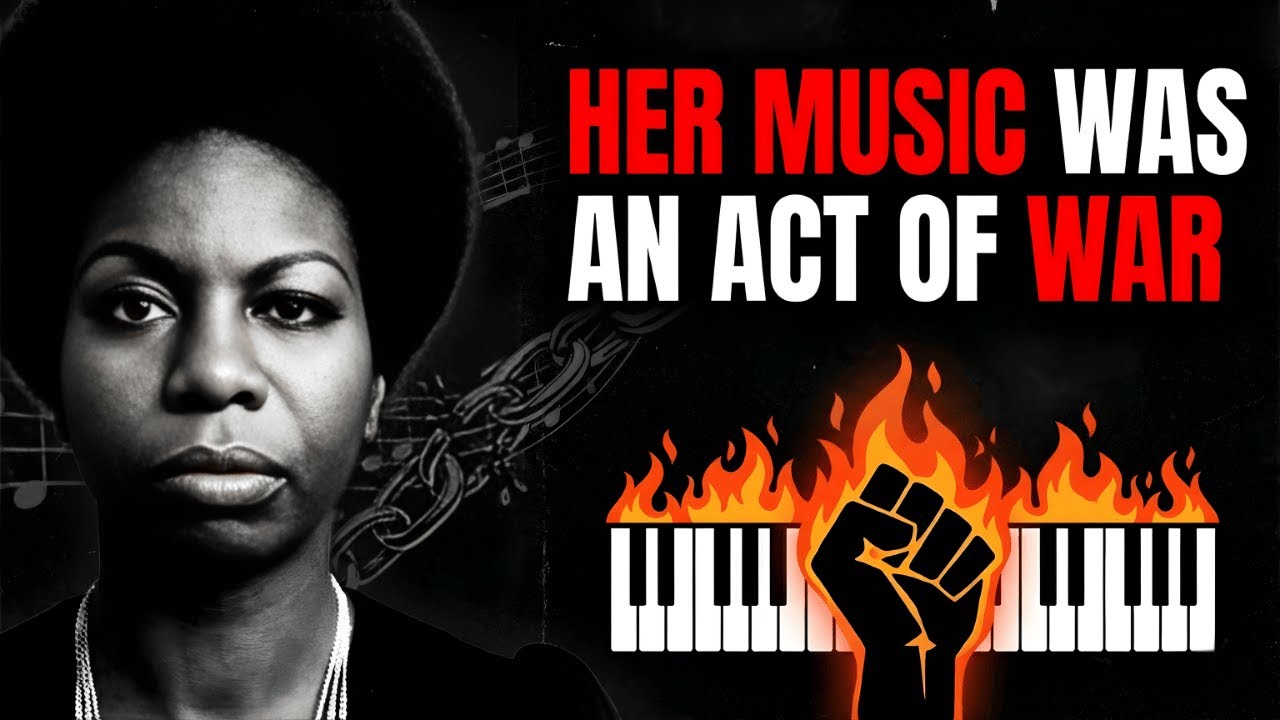
Nina Simone Wrote "Mississippi Goddam" in Under an Hour. The FBI Watched Her for Decades.
On September 15, 1963, four members of the Ku Klux Klan bombed the 16th Street Baptist Church in Birmingham, Alabama, killing four girls: Addie Mae Collins, Cynthia Wesley, Carole Robertson, and Carol Denise McNair. Three months earlier, Medgar Evers had been assassinated in his driveway in Jackson, Mississippi.
Nina Simone sat at her piano and wrote \u201cMississippi Goddam\u201d in under an hour. She described the process as involuntary — the song came out of her fully formed, propelled by a rage she could not contain. It was the first protest song she ever wrote.
She performed it at Carnegie Hall in March 1964. The audience, expecting the refined classical-jazz hybrid that had made Simone famous, heard instead a declaration of war: \u201cAlabama's got me so upset / Tennessee made me lose my rest / And everybody knows about Mississippi goddam.\u201d
The song was banned across the American South. Radio stations returned copies to the record label — some snapped in half. But it reached its audience anyway, and it transformed Nina Simone from a concert artist into a political figure.
The FBI's surveillance of Simone began in the mid-1960s and continued for years. Her file documents monitoring of her performances, her public statements, her associations with civil rights leaders, and her increasing radicalization. Simone performed at civil rights rallies, spoke at SNCC events, and publicly advocated for armed resistance — a position that placed her beyond what the mainstream movement would endorse.
The pressure was multidirectional. The FBI monitored her. The music industry punished her. After \u201cMississippi Goddam,\u201d Simone's relationship with record labels deteriorated. Her insistence on performing political material limited her commercial bookings. Venues that had welcomed her as a jazz pianist were less enthusiastic about a artist who opened sets by telling audiences about the murders of Black children.
Simone's financial situation collapsed through the late 1960s and 1970s. The IRS pursued her for back taxes — a pattern consistent with the experiences of other politically active Black artists. She left the United States in 1969, moving first to Barbados, then to Liberia, then to several European countries before settling in the south of France.
She described her departure as exile. America had taken her classical career — she was denied a scholarship to the Curtis Institute of Music, which she attributed to racism. America had then taken her commercial career when she refused to separate her art from her politics. She left because there was nothing left to take.
From France, Simone performed sporadically. Her concerts were legendary and unpredictable — she might play for two hours or walk off stage after twenty minutes. The mental health challenges she faced were documented but inadequately treated. She was eventually diagnosed with bipolar disorder.
Nina Simone died on April 21, 2003, in Carry-le-Rouet, France. She was seventy years old. In 2018, fifteen years after her death, the Curtis Institute awarded her a posthumous honorary degree.
The FBI file exists. The banned records exist. The IRS cases exist. A classically trained pianist wrote a song about murdered children, and the institutional response was surveillance, economic punishment, and exile. She wrote \u201cMississippi Goddam\u201d in under an hour. America spent decades making her pay for it.
The Surveillance State
The FBI’s interest was not coincidental. Under J. Edgar Hoover’s directorship, the Bureau maintained extensive surveillance programs targeting Black leaders, organizations, and cultural figures who challenged the racial status quo. COINTELPRO — the Counter Intelligence Program — was the formal structure, but the surveillance extended well beyond any single program. Field offices across the country maintained files, cultivated informants, and deployed agents to monitor, disrupt, and discredit individuals the Bureau deemed threatening to domestic order.
The methods were systematic: wiretaps, mail interception, infiltration of organizations, anonymous letters designed to destroy relationships and reputations, and coordination with local law enforcement to harass targets through arrests, tax audits, and public smear campaigns. The goal was not simply intelligence gathering — it was neutralization. The Bureau sought to prevent the rise of what internal memos described as a “Black messiah” who could unify and electrify the masses.
The Broader Struggle
This story did not unfold in isolation. It was part of a vast, interconnected struggle for equality that defined twentieth-century America. From the courtrooms to the streets, from the churches to the legislative chambers, Black Americans and their allies were challenging a system of racial oppression that had been embedded in law, custom, and daily life for centuries. Each individual story — each act of courage, each confrontation with power — was a thread in a larger tapestry of resistance.
What distinguished this era was the systematic nature of both the oppression and the resistance. The movement operated on multiple fronts simultaneously: legal challenges through organizations like the NAACP Legal Defense Fund, economic pressure through boycotts and selective buying campaigns, moral persuasion through nonviolent direct action, and cultural transformation through art, music, and literature that reframed the narrative of Black life in America.
Art as Resistance
Music was never just entertainment in this context — it was a weapon, a shield, and a declaration. Black artists who used their platform to address racial injustice understood that their art reached audiences that political speeches could not. A song could cross racial lines, enter homes through radio waves, and plant ideas in minds that might otherwise remain closed. The government understood this too, which is precisely why artists who spoke out became targets.
The relationship between Black music and political power has always been fraught. Record labels, concert promoters, and radio stations — overwhelmingly white-owned — controlled distribution and access. Artists who pushed too far politically risked losing airplay, bookings, and contracts. The choice between commercial success and authentic expression was rarely simple, and those who chose to speak truth through their art often paid a steep professional and personal price.
America’s Pattern of Exile
The forced departure of Black leaders, artists, and intellectuals from the United States represents one of the country’s most damaging patterns of self-inflicted cultural and intellectual loss. Throughout the twentieth century, America systematically drove away some of its most brilliant citizens — not through formal banishment, but through a campaign of harassment, economic pressure, and legal persecution that made remaining in the country untenable.
The list of Black Americans who lived in exile — voluntarily or otherwise — reads like a catalog of American genius. Writers, musicians, scientists, and activists found in Paris, London, Accra, and Havana the freedom to live and work without the constant threat of racial violence and government surveillance. Their departure impoverished American culture while enriching the nations that received them.
Why This Matters Now
This history is not merely an account of past events. It is a living document that shapes the present. The institutions that enabled these abuses — the FBI, local police departments, the courts — continue to operate today. The patterns of surveillance, suppression, and selective justice that defined the treatment of Black Americans in the twentieth century did not end with the passage of civil rights legislation. They evolved, adapted, and persisted in forms that are sometimes more subtle but no less consequential.
Understanding this history is essential not as an exercise in guilt or recrimination, but as a foundation for honest engagement with the ongoing challenges of racial justice in America. The stories of individuals who faced overwhelming institutional power and refused to surrender — who insisted on their dignity, their rights, and their humanity in the face of systematic attempts to deny all three — remain relevant because the struggle they waged is not over.
Leave a Reply