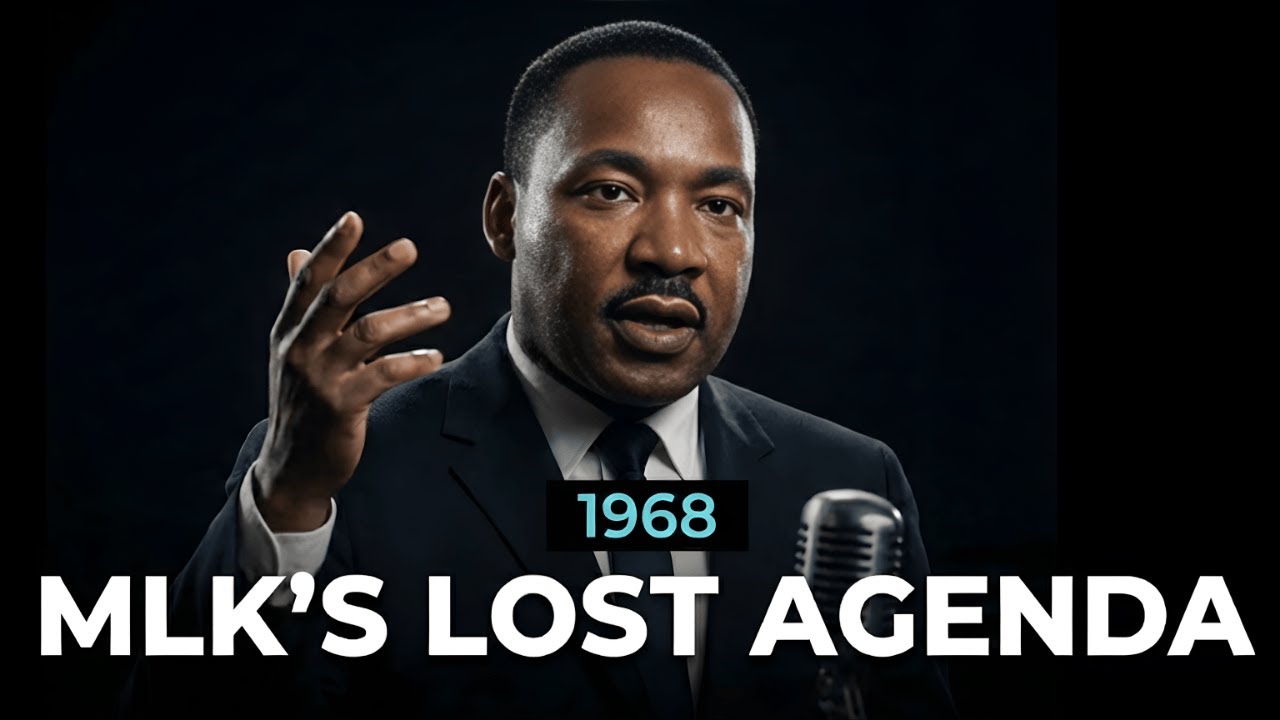
MLK's Lost Agenda: The Economic Justice Fight America Walked Away From
By 1967, Martin Luther King Jr. had shifted his focus from civil rights to economic justice—a pivot that made him more dangerous to the American establishment than he had ever been. The lunch counter sit-ins, the Freedom Rides, the March on Washington—these had demanded access to existing systems. But the Poor People's Campaign was something different. It demanded the restructuring of the systems themselves.
King announced the campaign in December 1967. He would bring thousands of impoverished Americans of all races to Washington, D.C. to demand a complete restructuring of the American economy. Not integration into poverty, but the elimination of poverty itself. Not access to segregated wealth, but a redistribution of wealth. He called for a guaranteed annual income—a radical proposal at the time, rejected by both political parties. He called for massive federal investment in jobs and housing. He called for an end to the Vietnam War, which was draining billions in resources while American cities deteriorated.
This was not the King that America wanted to remember. The establishment could tolerate the dreamer—the man with the dream of racial harmony. But they could not tolerate the organizer. J. Edgar Hoover, who had monitored King for years, understood this shift immediately. FBI surveillance intensified. The Bureau's files on King expanded. Wiretaps multiplied. Hoover saw in King's economic agenda something that transcended race: a threat to the class structure that had funded American power.
The media began portraying King as radical, reckless, moving beyond his lane. Time magazine, which had celebrated him months earlier, began questioning his judgment. His approval rating, which had been over 60% in 1965, dropped to 25% by 1968. The man America now claims to revere—the dreamer, the saint, the dreamer of racial harmony—was, in his final year, one of the most hated men in the country. Newspapers called him irresponsible. Civil rights organizations distanced themselves. He was isolated not by his opponents but by those who had claimed to support him.
On April 4, 1968, before the Poor People's Campaign could begin its work, before the encampment could be established in Washington, before the economic agenda could even be articulated to the nation, King was assassinated in Memphis. The campaign collapsed without him. The economic platform was abandoned. King became memory, monument, a dream safely removed from the present. The living King—the one demanding economic restructuring, demanding reparations, demanding the end of American militarism—was buried along with his body. History remembered the dreamer. It forgot the organizer.
The Surveillance State
The FBI’s interest was not coincidental. Under J. Edgar Hoover’s directorship, the Bureau maintained extensive surveillance programs targeting Black leaders, organizations, and cultural figures who challenged the racial status quo. COINTELPRO — the Counter Intelligence Program — was the formal structure, but the surveillance extended well beyond any single program. Field offices across the country maintained files, cultivated informants, and deployed agents to monitor, disrupt, and discredit individuals the Bureau deemed threatening to domestic order.
The methods were systematic: wiretaps, mail interception, infiltration of organizations, anonymous letters designed to destroy relationships and reputations, and coordination with local law enforcement to harass targets through arrests, tax audits, and public smear campaigns. The goal was not simply intelligence gathering — it was neutralization. The Bureau sought to prevent the rise of what internal memos described as a “Black messiah” who could unify and electrify the masses.
The Broader Struggle
This story did not unfold in isolation. It was part of a vast, interconnected struggle for equality that defined twentieth-century America. From the courtrooms to the streets, from the churches to the legislative chambers, Black Americans and their allies were challenging a system of racial oppression that had been embedded in law, custom, and daily life for centuries. Each individual story — each act of courage, each confrontation with power — was a thread in a larger tapestry of resistance.
What distinguished this era was the systematic nature of both the oppression and the resistance. The movement operated on multiple fronts simultaneously: legal challenges through organizations like the NAACP Legal Defense Fund, economic pressure through boycotts and selective buying campaigns, moral persuasion through nonviolent direct action, and cultural transformation through art, music, and literature that reframed the narrative of Black life in America.
Why This Matters Now
This history is not merely an account of past events. It is a living document that shapes the present. The institutions that enabled these abuses — the FBI, local police departments, the courts — continue to operate today. The patterns of surveillance, suppression, and selective justice that defined the treatment of Black Americans in the twentieth century did not end with the passage of civil rights legislation. They evolved, adapted, and persisted in forms that are sometimes more subtle but no less consequential.
Understanding this history is essential not as an exercise in guilt or recrimination, but as a foundation for honest engagement with the ongoing challenges of racial justice in America. The stories of individuals who faced overwhelming institutional power and refused to surrender — who insisted on their dignity, their rights, and their humanity in the face of systematic attempts to deny all three — remain relevant because the struggle they waged is not over.
The Economic Vision They Buried
King’s economic justice agenda was not a vague aspiration — it was a detailed policy platform that threatened the foundations of American capitalism. The Poor People’s Campaign, which King was organizing at the time of his assassination, demanded a $30 billion annual investment in anti-poverty programs, a guaranteed annual income for all Americans, and full employment legislation that would make the federal government the employer of last resort. These were not modest reforms — they were structural changes to the American economic system.
Leave a Reply