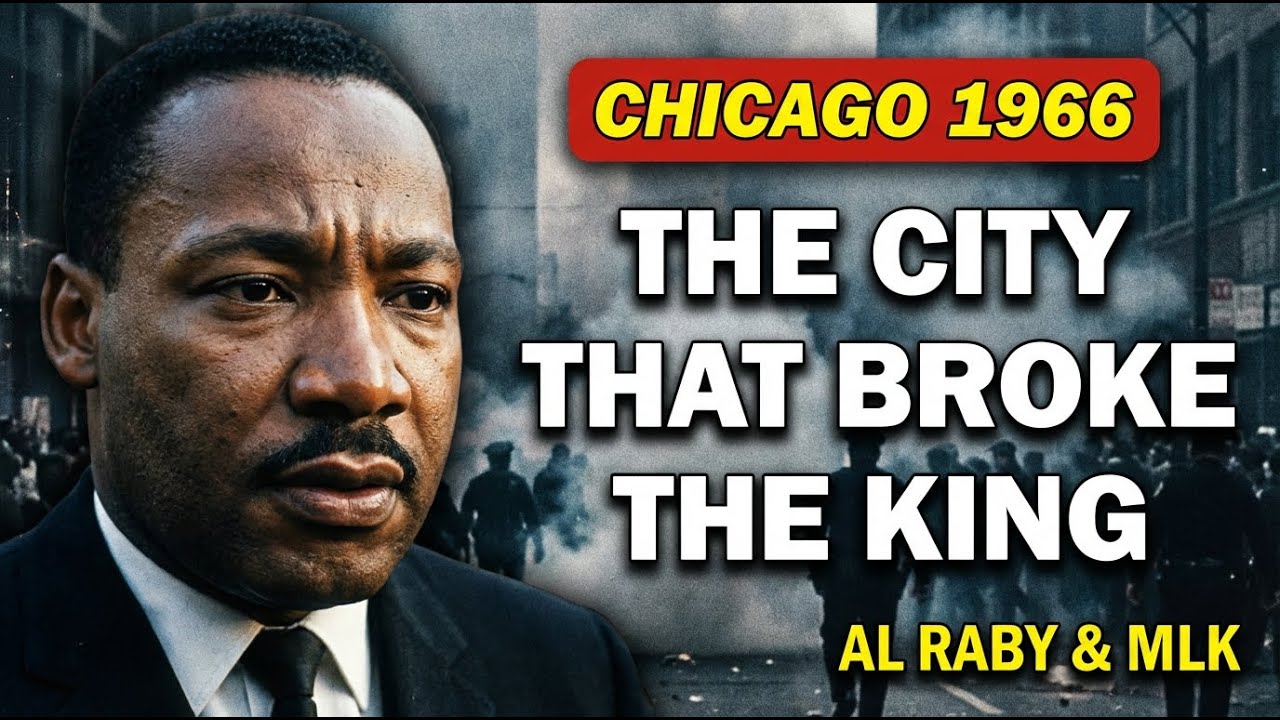
The Man Who Brought MLK to Chicago — And What the North Revealed
In 1966, Martin Luther King Jr. came north. He traveled to Chicago's West Side and announced that he would lead a campaign against Northern segregation—the system of housing discrimination, redlining, and residential apartheid that had transformed American cities into racially divided zones. He believed the principles that had guided the Southern movement could be applied to Northern racism. He was unprepared for what he encountered.
Northern segregation looked different than Southern segregation, but it functioned identically: it confined Black populations to deteriorating neighborhoods while white populations fled to the suburbs, accumulating wealth and resources in the process. The mechanisms were different—not explicit Jim Crow laws but racial covenants in property deeds, redlining practices by banks that refused to loan in Black neighborhoods, discriminatory hiring in the real estate industry, and the coordinated flight of white residents whenever Black families moved in. The result was the same. Chicago was one of the most segregated cities in America.
King's Chicago Freedom Movement targeted this segregation directly. The campaign focused on housing—demanding open housing laws that would permit Black families to purchase homes anywhere in the city. King led marches through white neighborhoods. On July 10, 1966, he marched into Marquette Park on Chicago's South Side, a predominantly white, working-class neighborhood. He was met with a mob of several thousand white residents throwing rocks, bottles, and firecrackers. The mob was violent and sustained. King, accustomed to Southern mobs, was shaken. He said later that the hatred he encountered in Chicago exceeded anything he had experienced in the South.
On August 5, 1966, King led another march through Marquette Park. The mob had grown larger and more violent. During the march, a rock was thrown from the crowd and struck King in the head. He fell to his knees. The photograph of that moment—King bloodied, on his knees, surrounded by a sea of white hatred—captured something that the sanitized Southern narrative had obscured: white America's commitment to maintaining racial separation was not a Southern regional pathology. It was national. It was Northern. It was everywhere.
What shocked King most was the response from white Northern liberals who had celebrated his Southern campaigns. When King demanded that Chicago desegregate its housing market, when he asked for open housing laws that would permit Black families to move freely, these same liberals recoiled. Northern racism, it turned out, was not a distant problem to be solved through goodwill and legislation. Northern racism was their segregation, their suburbs, their property values, their neighborhood schools. When King brought his demands north, the true nature of white Northern consensus was revealed.
King was forced to negotiate a compromise agreement on housing in Chicago, one that fell far short of the movement's demands. The campaign was considered a defeat. But King had accomplished something crucial: he had exposed the myth of Northern racial progressivism. He had demonstrated that the hatred he encountered in Chicago matched anything Mississippi could produce. And for this reason, the Chicago campaign has been systematically erased from the dominant historical narrative about King. The sanitized story focuses on the South—on victories, on moral clarity. The Northern campaign, the violence King encountered there, the resistance from white liberals—these remain largely invisible. Because they reveal truths that America prefers to ignore.
The Broader Struggle
This story did not unfold in isolation. It was part of a vast, interconnected struggle for equality that defined twentieth-century America. From the courtrooms to the streets, from the churches to the legislative chambers, Black Americans and their allies were challenging a system of racial oppression that had been embedded in law, custom, and daily life for centuries. Each individual story — each act of courage, each confrontation with power — was a thread in a larger tapestry of resistance.
What distinguished this era was the systematic nature of both the oppression and the resistance. The movement operated on multiple fronts simultaneously: legal challenges through organizations like the NAACP Legal Defense Fund, economic pressure through boycotts and selective buying campaigns, moral persuasion through nonviolent direct action, and cultural transformation through art, music, and literature that reframed the narrative of Black life in America.
Art as Resistance
Music was never just entertainment in this context — it was a weapon, a shield, and a declaration. Black artists who used their platform to address racial injustice understood that their art reached audiences that political speeches could not. A song could cross racial lines, enter homes through radio waves, and plant ideas in minds that might otherwise remain closed. The government understood this too, which is precisely why artists who spoke out became targets.
The relationship between Black music and political power has always been fraught. Record labels, concert promoters, and radio stations — overwhelmingly white-owned — controlled distribution and access. Artists who pushed too far politically risked losing airplay, bookings, and contracts. The choice between commercial success and authentic expression was rarely simple, and those who chose to speak truth through their art often paid a steep professional and personal price.
The Price of Resistance
The violence that punctuated the struggle for Black equality was not random. It was strategic, designed to terrorize communities into submission and to send a message to anyone who might consider challenging the racial order. Every killing, every beating, every act of destruction served a purpose within a system that depended on Black acquiescence for its survival.
What the perpetrators consistently underestimated was the resilience of the communities they targeted. Violence did not silence the movement — it amplified it. Each act of brutality created new activists, new allies, and new urgency. The photographs, the testimonies, and the names of the fallen became rallying points that sustained the struggle across generations.
America’s Pattern of Exile
The forced departure of Black leaders, artists, and intellectuals from the United States represents one of the country’s most damaging patterns of self-inflicted cultural and intellectual loss. Throughout the twentieth century, America systematically drove away some of its most brilliant citizens — not through formal banishment, but through a campaign of harassment, economic pressure, and legal persecution that made remaining in the country untenable.
The list of Black Americans who lived in exile — voluntarily or otherwise — reads like a catalog of American genius. Writers, musicians, scientists, and activists found in Paris, London, Accra, and Havana the freedom to live and work without the constant threat of racial violence and government surveillance. Their departure impoverished American culture while enriching the nations that received them.
Why This Matters Now
This history is not merely an account of past events. It is a living document that shapes the present. The institutions that enabled these abuses — the FBI, local police departments, the courts — continue to operate today. The patterns of surveillance, suppression, and selective justice that defined the treatment of Black Americans in the twentieth century did not end with the passage of civil rights legislation. They evolved, adapted, and persisted in forms that are sometimes more subtle but no less consequential.
Understanding this history is essential not as an exercise in guilt or recrimination, but as a foundation for honest engagement with the ongoing challenges of racial justice in America. The stories of individuals who faced overwhelming institutional power and refused to surrender — who insisted on their dignity, their rights, and their humanity in the face of systematic attempts to deny all three — remain relevant because the struggle they waged is not over.
Leave a Reply