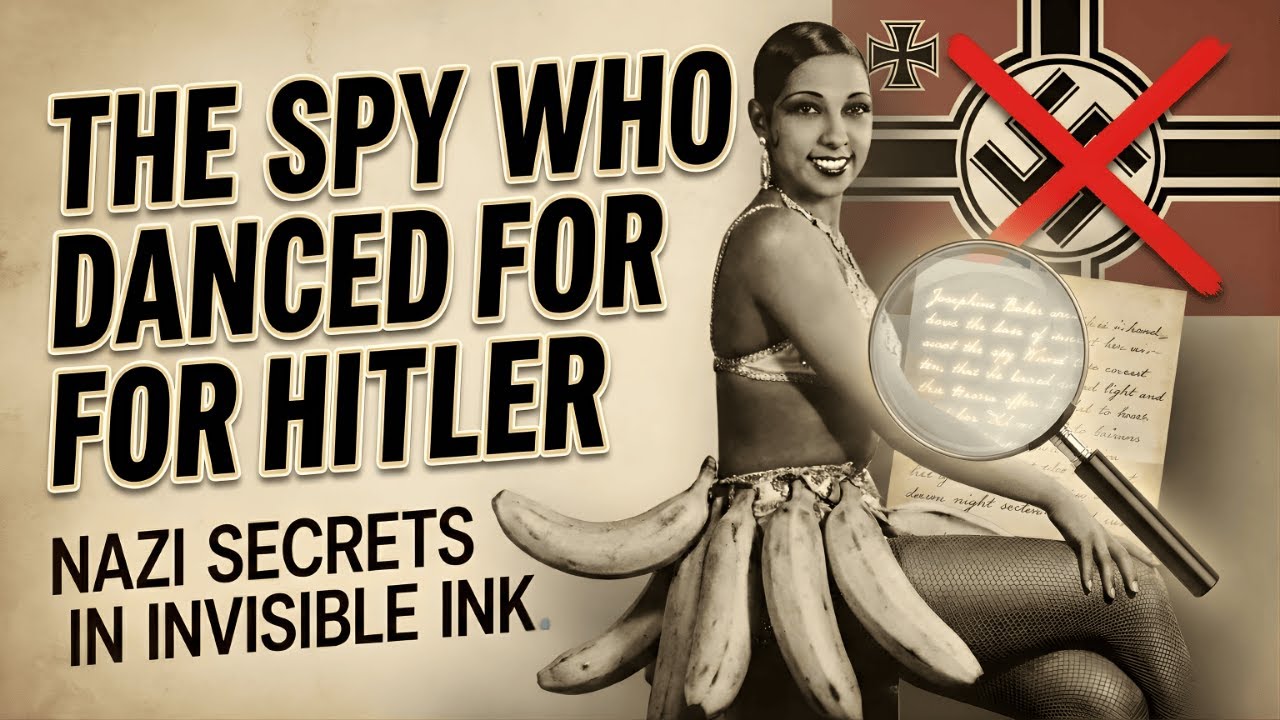
Josephine Baker Spied for the French Resistance While the FBI Tracked Her for Being Black and Defiant
Josephine Baker left the United States in 1925 at age nineteen. She arrived in Paris and became the most famous entertainer in Europe within a year. She chose France because, as she said, \u201cI could not live where people treated me the way Americans treated me.\u201d
When Germany invaded France in 1940, Baker joined the French Resistance. Her contribution was not symbolic. She was recruited by Jacques Abtey, head of French military counterintelligence, as an intelligence operative. Her celebrity provided cover that no professional spy could replicate: she traveled freely across borders, attended diplomatic receptions, and moved through social circles where military and political information circulated openly.
Baker smuggled intelligence reports written in invisible ink on her sheet music. She pinned notes inside her underwear. She transmitted information gathered at embassy parties to Free French operatives. Her work for the Deuxieme Bureau — French military intelligence — continued throughout the war. She was stationed in North Africa, where she used her performances as cover for intelligence-gathering missions.
France awarded Baker the Croix de Guerre, the Rosette de la Resistance, and ultimately the Legion of Honor — the highest French distinction. She was made a Chevalier of the Legion by Charles de Gaulle himself.
The United States, meanwhile, maintained an FBI file on her.
Baker's Bureau file documents surveillance that began in the 1940s and continued through the 1960s. The FBI monitored her because of her political activities — specifically, her vocal opposition to racial segregation in the United States. When Baker returned to America for performances, she refused to perform before segregated audiences. She insisted on integrated seating at every venue, a demand that was considered radical in the 1950s.
In 1951, Baker was denied service at the Stork Club in New York City. She reported the incident publicly. The Stork Club's owner, Sherman Billingsley, was an associate of J. Edgar Hoover. Walter Winchell, the most powerful gossip columnist in America and a close Hoover ally, attacked Baker in his column, calling her a communist sympathizer.
The FBI's file expanded after the Stork Club incident. Agents tracked her public statements, her associations with civil rights leaders, and her international travel. The Bureau characterized her anti-segregation advocacy as potentially subversive. A woman who had risked her life gathering intelligence for the Allied cause was surveilled by her own country for demanding to be treated as equal.
In August 1963, Baker was the only woman to speak at the March on Washington. She addressed the crowd in her Free French uniform, wearing her Legion of Honor medal. She told the audience about leaving America because of racism and finding dignity in France. She was fifty-seven years old.
Josephine Baker died on April 12, 1975, in Paris, four days after a sold-out retrospective performance celebrating her fifty years in entertainment. France gave her a full military funeral — the first American-born woman to receive military honors from France.
The FBI file remains. The woman who smuggled intelligence past Nazi checkpoints was treated as a security concern by her own government. France honored her as a hero. America watched her as a threat. She chose France. The file explains why.
The Surveillance State
The FBI’s interest was not coincidental. Under J. Edgar Hoover’s directorship, the Bureau maintained extensive surveillance programs targeting Black leaders, organizations, and cultural figures who challenged the racial status quo. COINTELPRO — the Counter Intelligence Program — was the formal structure, but the surveillance extended well beyond any single program. Field offices across the country maintained files, cultivated informants, and deployed agents to monitor, disrupt, and discredit individuals the Bureau deemed threatening to domestic order.
The methods were systematic: wiretaps, mail interception, infiltration of organizations, anonymous letters designed to destroy relationships and reputations, and coordination with local law enforcement to harass targets through arrests, tax audits, and public smear campaigns. The goal was not simply intelligence gathering — it was neutralization. The Bureau sought to prevent the rise of what internal memos described as a “Black messiah” who could unify and electrify the masses.
The Broader Struggle
This story did not unfold in isolation. It was part of a vast, interconnected struggle for equality that defined twentieth-century America. From the courtrooms to the streets, from the churches to the legislative chambers, Black Americans and their allies were challenging a system of racial oppression that had been embedded in law, custom, and daily life for centuries. Each individual story — each act of courage, each confrontation with power — was a thread in a larger tapestry of resistance.
What distinguished this era was the systematic nature of both the oppression and the resistance. The movement operated on multiple fronts simultaneously: legal challenges through organizations like the NAACP Legal Defense Fund, economic pressure through boycotts and selective buying campaigns, moral persuasion through nonviolent direct action, and cultural transformation through art, music, and literature that reframed the narrative of Black life in America.
Art as Resistance
Music was never just entertainment in this context — it was a weapon, a shield, and a declaration. Black artists who used their platform to address racial injustice understood that their art reached audiences that political speeches could not. A song could cross racial lines, enter homes through radio waves, and plant ideas in minds that might otherwise remain closed. The government understood this too, which is precisely why artists who spoke out became targets.
The relationship between Black music and political power has always been fraught. Record labels, concert promoters, and radio stations — overwhelmingly white-owned — controlled distribution and access. Artists who pushed too far politically risked losing airplay, bookings, and contracts. The choice between commercial success and authentic expression was rarely simple, and those who chose to speak truth through their art often paid a steep professional and personal price.
Why This Matters Now
This history is not merely an account of past events. It is a living document that shapes the present. The institutions that enabled these abuses — the FBI, local police departments, the courts — continue to operate today. The patterns of surveillance, suppression, and selective justice that defined the treatment of Black Americans in the twentieth century did not end with the passage of civil rights legislation. They evolved, adapted, and persisted in forms that are sometimes more subtle but no less consequential.
Understanding this history is essential not as an exercise in guilt or recrimination, but as a foundation for honest engagement with the ongoing challenges of racial justice in America. The stories of individuals who faced overwhelming institutional power and refused to surrender — who insisted on their dignity, their rights, and their humanity in the face of systematic attempts to deny all three — remain relevant because the struggle they waged is not over.
Leave a Reply