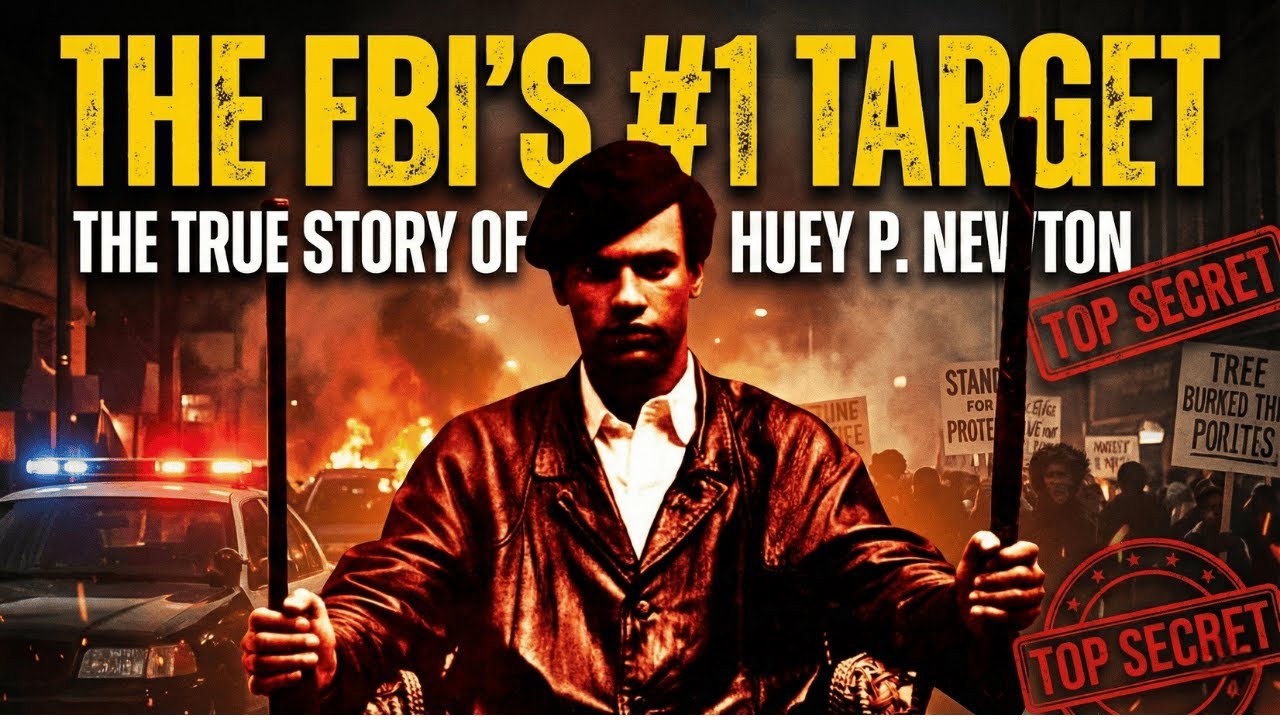
The FBI Ran 233 Separate COINTELPRO Operations Against the Black Panther Party Huey Newton Founded
On September 8, 1968, J. Edgar Hoover issued an internal FBI directive designating the Black Panther Party as \u201cthe greatest threat to the internal security of the country.\u201d The directive authorized a comprehensive COINTELPRO campaign. Between 1968 and 1971, the Bureau conducted 233 separate operations against the Panthers — more than against any other domestic organization in COINTELPRO history.
Huey P. Newton co-founded the Party in October 1966 in Oakland, California. The original platform was a ten-point program demanding employment, housing, education, and an end to police brutality. The Panthers also exercised their legal right under California law to carry loaded firearms in public while observing police interactions in Black neighborhoods. This practice — which they called \u201cpolice patrols\u201d — was legal. It terrified the establishment.
The FBI's campaign against the Panthers was systematic. The 233 documented operations included: infiltrating every chapter with informants; fabricating letters to create internal conflicts; sending anonymous communications to rival organizations to provoke violent confrontations; pressuring landlords to evict Panther offices; coordinating with local police departments to conduct raids; and targeting the Party's free breakfast programs and medical clinics for disruption.
Newton's personal file was among the Bureau's most active. On October 28, 1967, Newton was shot during a confrontation with Oakland police officer John Frey, who was killed. Newton was charged with murder, convicted of voluntary manslaughter, and sentenced to two to fifteen years. The conviction was overturned on appeal in 1970 due to procedural errors. Two subsequent trials ended in hung juries. The charges were dismissed.
During Newton's imprisonment, the FBI accelerated its campaign against the Panthers. Internal Bureau documents show that the Los Angeles field office recommended exploiting Newton's incarceration to create a leadership vacuum. Simultaneously, the Bureau used informants to manufacture conflicts between the Newton faction and Eldridge Cleaver, who was in exile in Algeria. Fabricated letters attributed to each faction were sent to Panther chapters nationwide.
The Free Breakfast for Children Program became a specific target. FBI memos directed field offices to \u201ceradicate\u201d the program because it was generating positive community support. Agents contacted churches and community centers hosting breakfast sites, spreading false information about food contamination and Panther misconduct. The Bureau's own documents describe this as a priority because the program was \u201cthe best thing the BPP is doing.\u201d
By 1971, the combined effect of COINTELPRO — raids, prosecutions, assassinations, internal sabotage, and informant operations — had fractured the Party. Newton attempted to redirect the organization toward community programs, but the damage was structural. Key leaders were dead (Fred Hampton, Mark Clark), imprisoned (Geronimo Pratt, the Panther 21), or in exile (Cleaver, Assata Shakur).
Huey Newton was shot and killed on August 22, 1989, in Oakland. He was forty-seven. His killer, Tyrone Robinson, was convicted of the murder.
The 233 COINTELPRO operations against the Panthers were documented by the Church Committee in 1975. The Senate investigation revealed that the FBI had treated a constitutionally protected political organization as an enemy to be destroyed. The Bureau did not investigate crimes by the Panthers. It mounted a campaign to eliminate the organization itself.
The files are declassified. The 233 operations are enumerated. The memos targeting the breakfast program are public. And the FBI's own designation — \u201cgreatest threat to internal security\u201d — was applied to an organization whose most effective program was feeding children before school.
The Surveillance State
The FBI’s interest was not coincidental. Under J. Edgar Hoover’s directorship, the Bureau maintained extensive surveillance programs targeting Black leaders, organizations, and cultural figures who challenged the racial status quo. COINTELPRO — the Counter Intelligence Program — was the formal structure, but the surveillance extended well beyond any single program. Field offices across the country maintained files, cultivated informants, and deployed agents to monitor, disrupt, and discredit individuals the Bureau deemed threatening to domestic order.
The methods were systematic: wiretaps, mail interception, infiltration of organizations, anonymous letters designed to destroy relationships and reputations, and coordination with local law enforcement to harass targets through arrests, tax audits, and public smear campaigns. The goal was not simply intelligence gathering — it was neutralization. The Bureau sought to prevent the rise of what internal memos described as a “Black messiah” who could unify and electrify the masses.
Justice Deferred
The legal dimensions of this case reveal how the American justice system has historically functioned as both a tool of liberation and a mechanism of oppression. Courts that were capable of landmark civil rights decisions were equally capable of producing outcomes that reinforced racial hierarchies. The same Constitution that guaranteed equal protection under the law was interpreted, for generations, to permit systematic racial discrimination.
What the legal record shows is that justice, when it came at all, came slowly and incompletely. Cases dragged on for years. Evidence was suppressed, witnesses were intimidated, and juries were selected from pools that excluded Black citizens. The system worked exactly as it was designed to work — not to deliver impartial justice, but to maintain the existing social order. When that order was finally challenged, the system resisted with every tool at its disposal.
America’s Pattern of Exile
The forced departure of Black leaders, artists, and intellectuals from the United States represents one of the country’s most damaging patterns of self-inflicted cultural and intellectual loss. Throughout the twentieth century, America systematically drove away some of its most brilliant citizens — not through formal banishment, but through a campaign of harassment, economic pressure, and legal persecution that made remaining in the country untenable.
The list of Black Americans who lived in exile — voluntarily or otherwise — reads like a catalog of American genius. Writers, musicians, scientists, and activists found in Paris, London, Accra, and Havana the freedom to live and work without the constant threat of racial violence and government surveillance. Their departure impoverished American culture while enriching the nations that received them.
Why This Matters Now
This history is not merely an account of past events. It is a living document that shapes the present. The institutions that enabled these abuses — the FBI, local police departments, the courts — continue to operate today. The patterns of surveillance, suppression, and selective justice that defined the treatment of Black Americans in the twentieth century did not end with the passage of civil rights legislation. They evolved, adapted, and persisted in forms that are sometimes more subtle but no less consequential.
Understanding this history is essential not as an exercise in guilt or recrimination, but as a foundation for honest engagement with the ongoing challenges of racial justice in America. The stories of individuals who faced overwhelming institutional power and refused to surrender — who insisted on their dignity, their rights, and their humanity in the face of systematic attempts to deny all three — remain relevant because the struggle they waged is not over.
Leave a Reply