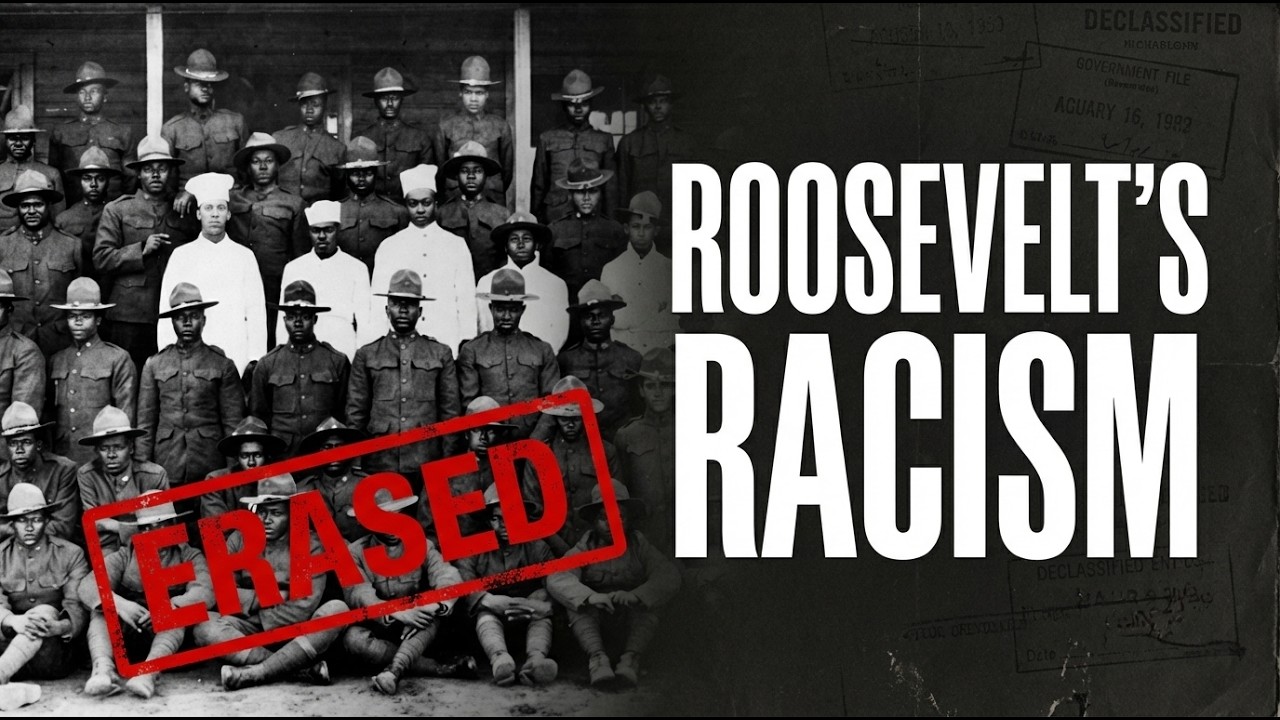
How Teddy Roosevelt Destroyed 167 Buffalo Soldiers
In 1972, an 87-year-old man sat in a leather chair at a downtown Minneapolis barbershop. He had been shining shoes in that same shop for 59 years. His name was Dorsey Willis. That morning, a government envelope arrived containing two things: a check for $25,000 and a piece of paper that said “honorable discharge” from the United States Army. Willis had been waiting 66 years for that piece of paper. He was the last one alive. The other 166 men who served beside him in the 25th United States Infantry Regiment — the legendary Buffalo Soldiers — had all died with dishonorable discharges on their military records.
None of them ever got a hearing. None of them ever got a trial. And the evidence that destroyed them had been fabricated.
The Buffalo Soldiers’ Record
The Buffalo Soldiers of the 25th Infantry had earned 18 Medals of Honor across four decades of frontier combat. They fought in blue wool uniforms through dust storms on the Great Plains, through jungle heat in the Philippines, and up the hills of Cuba during the Spanish-American War in 1898. Their commanding officer in Cuba was Theodore Roosevelt himself. First Sergeant Mingo Sanders had worn the uniform for over 20 years and had ridden with the experimental Bicycle Corps on an 1,800-mile journey across the American West. These were career soldiers who had spent decades proving their value to a country that did not want to see it.
Brownsville, 1906
On July 28, 1906, the first battalion transferred by train to Fort Brown — a dusty military garrison on the banks of the Rio Grande in Brownsville, Texas. The town’s white residents had tolerated the all-white unit stationed there before. Armed Black soldiers with federal authority walking through a Jim Crow town was something else entirely.
Tensions built for two weeks. On August 13, a white woman accused a Black soldier of harassment. No evidence supported the claim. Major Charles Penrose confined all soldiers to their barracks that evening. Around midnight, gunfire cracked through the streets between the garrison walls and the storefronts of Brownsville. A bartender named Frank Natus was killed behind his saloon counter. A police lieutenant named Joe Dominguez was wounded.
By sunrise, the white citizens of Brownsville had already decided the Black soldiers did it. But the Army’s own record said otherwise. Major Penrose ran a roll call inside the barracks within minutes — every soldier was present. He ordered a weapons check. Every Springfield rifle was clean, unfired, standing in its rack. A sentry posted at the fort’s perimeter wall reported hearing pistol shots from outside the military reservation.
Roosevelt’s Decision
The evidence pointed away from the soldiers. Shell casings found in the streets were Army-issue Springfield rounds — but the casings showed signs of being planted. They were scattered too neatly, too visibly, in locations soldiers confined to barracks could not have reached. Military investigators noted the inconsistencies. It didn’t matter.
President Theodore Roosevelt — the same man who had commanded Black soldiers in Cuba, who knew exactly who the Buffalo Soldiers were — ordered all 167 men dishonorably discharged. Not court-martialed. Not tried. Discharged without hearing, without evidence, without due process. The order was issued on November 5, 1906 — the day after midterm elections, timed to avoid political consequences.
A dishonorable discharge didn’t just end a military career. It destroyed pensions, veterans’ benefits, and employment prospects. Men who had served 20 or 25 years lost everything overnight. First Sergeant Mingo Sanders — two decades of decorated service — walked out of Fort Brown with nothing.
The Cover-Up and the Correction
Senator Joseph Foraker of Ohio challenged Roosevelt’s decision, producing evidence that the shooting had been staged by Brownsville residents to frame the soldiers. Roosevelt responded by ordering military intelligence to investigate Foraker’s personal life, effectively ending his political career. The message was clear: challenge this decision and you’ll be destroyed.
It took 66 years for the United States to acknowledge the injustice. In 1972, the Army changed all 167 discharges to honorable. By then, only one man was still alive to receive the correction — Dorsey Willis, shining shoes in a Minneapolis barbershop, waiting for a piece of paper that said the Army had been wrong.
The $25,000 check was the government’s idea of compensation for 66 years of a dishonored life. Willis accepted it. He had no choice. The other 166 men died without ever seeing it.
The Surveillance State
The FBI’s interest was not coincidental. Under J. Edgar Hoover’s directorship, the Bureau maintained extensive surveillance programs targeting Black leaders, organizations, and cultural figures who challenged the racial status quo. COINTELPRO — the Counter Intelligence Program — was the formal structure, but the surveillance extended well beyond any single program. Field offices across the country maintained files, cultivated informants, and deployed agents to monitor, disrupt, and discredit individuals the Bureau deemed threatening to domestic order.
The methods were systematic: wiretaps, mail interception, infiltration of organizations, anonymous letters designed to destroy relationships and reputations, and coordination with local law enforcement to harass targets through arrests, tax audits, and public smear campaigns. The goal was not simply intelligence gathering — it was neutralization. The Bureau sought to prevent the rise of what internal memos described as a “Black messiah” who could unify and electrify the masses.
Art as Resistance
Music was never just entertainment in this context — it was a weapon, a shield, and a declaration. Black artists who used their platform to address racial injustice understood that their art reached audiences that political speeches could not. A song could cross racial lines, enter homes through radio waves, and plant ideas in minds that might otherwise remain closed. The government understood this too, which is precisely why artists who spoke out became targets.
The relationship between Black music and political power has always been fraught. Record labels, concert promoters, and radio stations — overwhelmingly white-owned — controlled distribution and access. Artists who pushed too far politically risked losing airplay, bookings, and contracts. The choice between commercial success and authentic expression was rarely simple, and those who chose to speak truth through their art often paid a steep professional and personal price.
Justice Deferred
The legal dimensions of this case reveal how the American justice system has historically functioned as both a tool of liberation and a mechanism of oppression. Courts that were capable of landmark civil rights decisions were equally capable of producing outcomes that reinforced racial hierarchies. The same Constitution that guaranteed equal protection under the law was interpreted, for generations, to permit systematic racial discrimination.
What the legal record shows is that justice, when it came at all, came slowly and incompletely. Cases dragged on for years. Evidence was suppressed, witnesses were intimidated, and juries were selected from pools that excluded Black citizens. The system worked exactly as it was designed to work — not to deliver impartial justice, but to maintain the existing social order. When that order was finally challenged, the system resisted with every tool at its disposal.
Why This Matters Now
This history is not merely an account of past events. It is a living document that shapes the present. The institutions that enabled these abuses — the FBI, local police departments, the courts — continue to operate today. The patterns of surveillance, suppression, and selective justice that defined the treatment of Black Americans in the twentieth century did not end with the passage of civil rights legislation. They evolved, adapted, and persisted in forms that are sometimes more subtle but no less consequential.
Understanding this history is essential not as an exercise in guilt or recrimination, but as a foundation for honest engagement with the ongoing challenges of racial justice in America. The stories of individuals who faced overwhelming institutional power and refused to surrender — who insisted on their dignity, their rights, and their humanity in the face of systematic attempts to deny all three — remain relevant because the struggle they waged is not over.
Leave a Reply