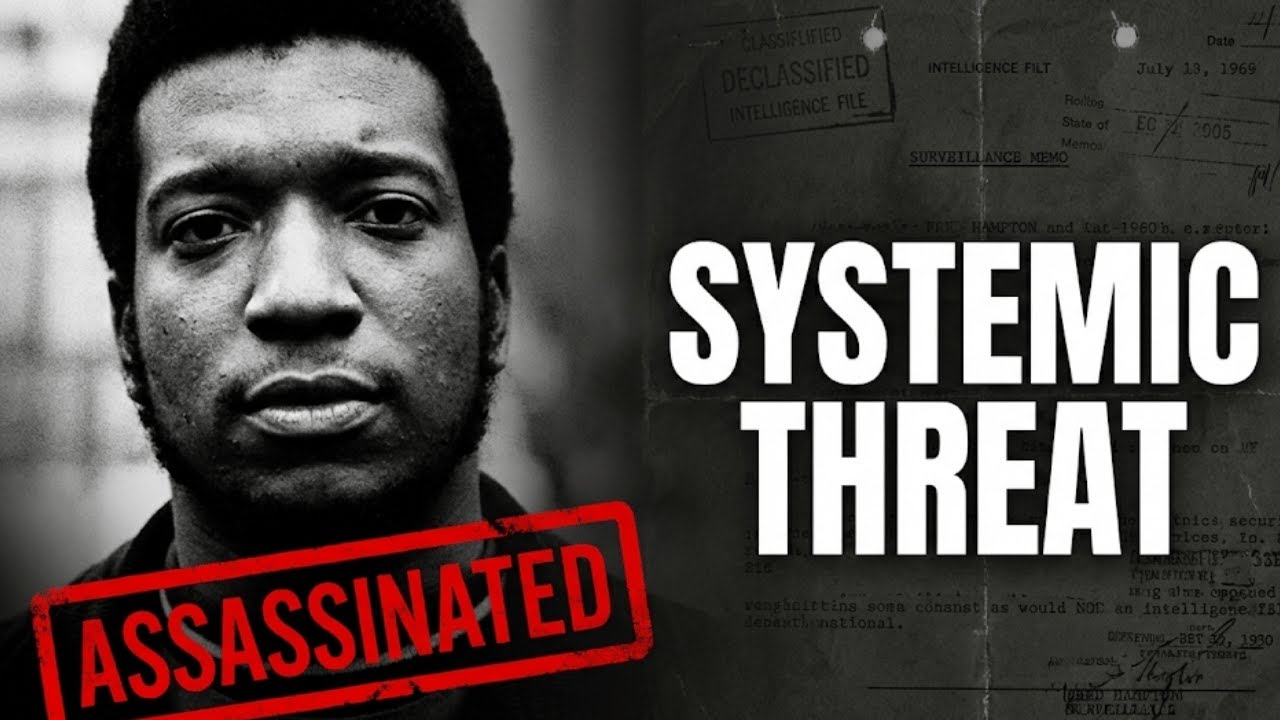
The FBI Memo That Authorized the Murder of Fred Hampton
On December 4, 1969, at 4:45 AM, fourteen Chicago police officers fired ninety-nine rounds into a West Side apartment. One round came from inside. Fred Hampton, the 21-year-old chairman of the Illinois Black Panther Party, never woke up. He was drugged — a barbiturate slipped into his drink hours earlier by FBI informant William O'Neal.
This is not speculation. This is documented.
COINTELPRO File #100-44018 reveals that FBI Director J. Edgar Hoover had identified Hampton as a "key agitator" and a threat to national security fourteen months before the raid. A memo dated January 1969 instructed the Chicago field office to "neutralize" Hampton using "any means necessary." O'Neal, who had infiltrated the Panthers at age seventeen, provided the Bureau with a hand-drawn floor plan of Hampton's apartment. He marked the bed where Hampton slept.
The floor plan was entered into evidence during the 1982 civil rights lawsuit. The red X on the diagram matched the exact position where Hampton's body was found.
Hampton had accomplished more by age twenty-one than most political organizers achieve in a lifetime. He brokered the original Rainbow Coalition — not Jesse Jackson's later version, but the street-level alliance between the Black Panthers, the Young Patriots (a white Appalachian organization), and the Young Lords (a Puerto Rican activist group). This coalition terrified the Bureau because it shattered the premise that Black radical politics could be contained through racial isolation.
An internal FBI memo from March 1969 states explicitly: "Hampton's Rainbow Coalition represents the most significant threat to the established order in Chicago. His ability to unify across racial lines must be disrupted."
The disruption was comprehensive. O'Neal was tasked with creating internal conflict within the Panthers, fabricating tensions between Hampton and rival organizations, and reporting on every meeting, phone call, and personal relationship. His handler, FBI Special Agent Roy Mitchell, met with O'Neal an average of once per week throughout 1969.
The night of the raid, O'Neal served Hampton a drink laced with secobarbital. Toxicology reports confirmed the barbiturate in Hampton's system. He was unconscious when police entered the apartment. Officers fired two shots point-blank into his head. The first officers through the door later testified they encountered no resistance.
Cook County State's Attorney Edward Hanrahan orchestrated the raid. He told the press the Panthers had opened fire and that police responded with restraint. Forensic evidence destroyed this narrative: of the 99 rounds fired, 98 came from police weapons. The single Panther round was later traced to Mark Clark, who reflexively discharged his shotgun as he was killed in the initial volley.
A federal grand jury declined to indict any officers. It took thirteen years of litigation before O'Neal's role was confirmed through declassified documents. In 1982, a civil settlement of $1.85 million was paid to the families — but no officer, agent, or informant was ever criminally charged.
O'Neal received a bonus from the FBI after the raid. The amount: $300. He later received a gas station as additional compensation for his services. In January 1990, the night the documentary "Eyes on the Prize II" aired footage of his confession, William O'Neal ran onto the Eisenhower Expressway and was struck by a car. His death was ruled a suicide.
Fred Hampton's apartment was never treated as a crime scene. The bullet holes were patched within days. But the floor plan — O'Neal's floor plan, with the red X — survived in the Bureau's own files. They documented their own operation and then classified it for two decades.
The files are declassified now. The red X is public record. And the coalition Hampton built — the idea that oppressed communities across racial lines could organize together — remains the most dangerous idea the FBI ever tried to kill.
The Surveillance State
The FBI’s interest was not coincidental. Under J. Edgar Hoover’s directorship, the Bureau maintained extensive surveillance programs targeting Black leaders, organizations, and cultural figures who challenged the racial status quo. COINTELPRO — the Counter Intelligence Program — was the formal structure, but the surveillance extended well beyond any single program. Field offices across the country maintained files, cultivated informants, and deployed agents to monitor, disrupt, and discredit individuals the Bureau deemed threatening to domestic order.
The methods were systematic: wiretaps, mail interception, infiltration of organizations, anonymous letters designed to destroy relationships and reputations, and coordination with local law enforcement to harass targets through arrests, tax audits, and public smear campaigns. The goal was not simply intelligence gathering — it was neutralization. The Bureau sought to prevent the rise of what internal memos described as a “Black messiah” who could unify and electrify the masses.
The Broader Struggle
This story did not unfold in isolation. It was part of a vast, interconnected struggle for equality that defined twentieth-century America. From the courtrooms to the streets, from the churches to the legislative chambers, Black Americans and their allies were challenging a system of racial oppression that had been embedded in law, custom, and daily life for centuries. Each individual story — each act of courage, each confrontation with power — was a thread in a larger tapestry of resistance.
What distinguished this era was the systematic nature of both the oppression and the resistance. The movement operated on multiple fronts simultaneously: legal challenges through organizations like the NAACP Legal Defense Fund, economic pressure through boycotts and selective buying campaigns, moral persuasion through nonviolent direct action, and cultural transformation through art, music, and literature that reframed the narrative of Black life in America.
Art as Resistance
Music was never just entertainment in this context — it was a weapon, a shield, and a declaration. Black artists who used their platform to address racial injustice understood that their art reached audiences that political speeches could not. A song could cross racial lines, enter homes through radio waves, and plant ideas in minds that might otherwise remain closed. The government understood this too, which is precisely why artists who spoke out became targets.
The relationship between Black music and political power has always been fraught. Record labels, concert promoters, and radio stations — overwhelmingly white-owned — controlled distribution and access. Artists who pushed too far politically risked losing airplay, bookings, and contracts. The choice between commercial success and authentic expression was rarely simple, and those who chose to speak truth through their art often paid a steep professional and personal price.
Justice Deferred
The legal dimensions of this case reveal how the American justice system has historically functioned as both a tool of liberation and a mechanism of oppression. Courts that were capable of landmark civil rights decisions were equally capable of producing outcomes that reinforced racial hierarchies. The same Constitution that guaranteed equal protection under the law was interpreted, for generations, to permit systematic racial discrimination.
What the legal record shows is that justice, when it came at all, came slowly and incompletely. Cases dragged on for years. Evidence was suppressed, witnesses were intimidated, and juries were selected from pools that excluded Black citizens. The system worked exactly as it was designed to work — not to deliver impartial justice, but to maintain the existing social order. When that order was finally challenged, the system resisted with every tool at its disposal.
Why This Matters Now
This history is not merely an account of past events. It is a living document that shapes the present. The institutions that enabled these abuses — the FBI, local police departments, the courts — continue to operate today. The patterns of surveillance, suppression, and selective justice that defined the treatment of Black Americans in the twentieth century did not end with the passage of civil rights legislation. They evolved, adapted, and persisted in forms that are sometimes more subtle but no less consequential.
Understanding this history is essential not as an exercise in guilt or recrimination, but as a foundation for honest engagement with the ongoing challenges of racial justice in America. The stories of individuals who faced overwhelming institutional power and refused to surrender — who insisted on their dignity, their rights, and their humanity in the face of systematic attempts to deny all three — remain relevant because the struggle they waged is not over.
Leave a Reply