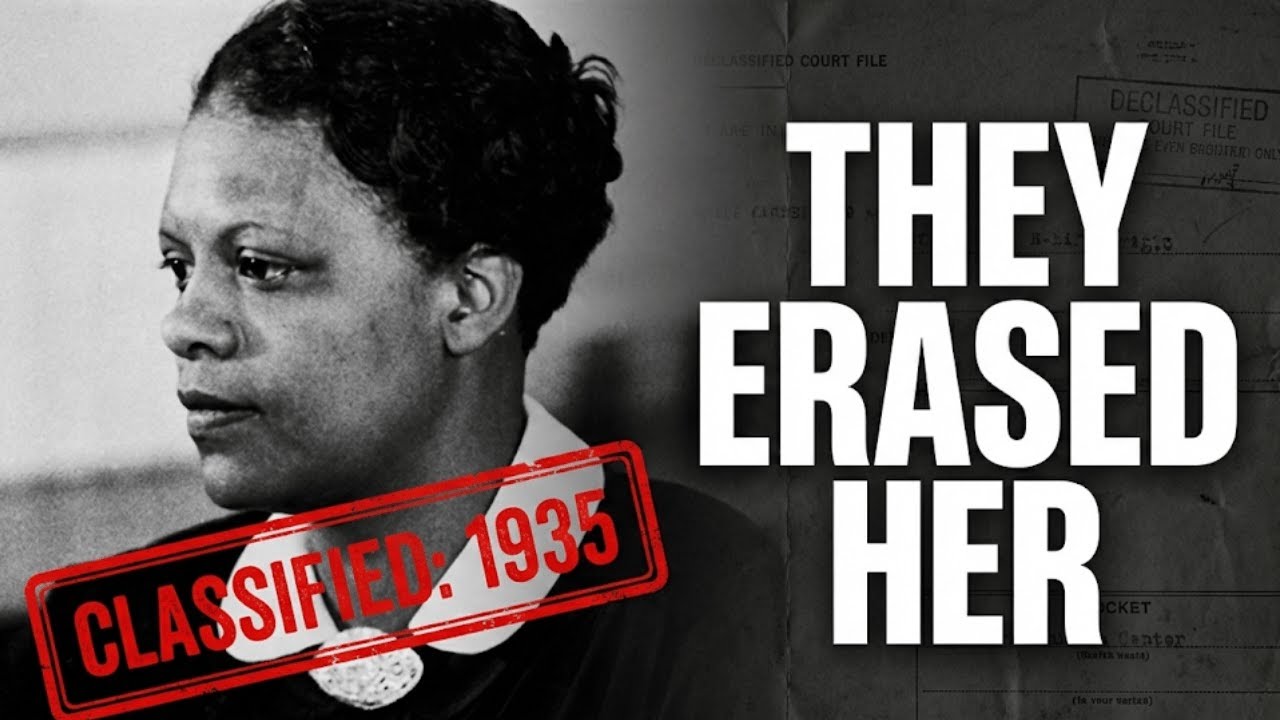
Eunice Hunton: The Untold Story of a Black Woman Who Took Down the Mob
Eunice Hunton Carter was a contradiction to every system designed to exclude her: a Black woman in a 1930s New York prosecutor's office at a moment when both her race and gender made her presence an anomaly. She arrived at the District Attorney's office in Manhattan in 1933, the first Black woman hired as an assistant district attorney in New York. The institution that employed her was built on centuries of precedent that women—particularly Black women—had no place in the machinery of criminal law. But Carter was not there to be accommodated. She was there to see what others could not.
The organized crime landscape of 1930s New York was controlled by a network of mobsters operating under the umbrella of Lucky Luciano and Meyer Lansky. These men had spent decades consolidating power through murder, extortion, and the systematic exploitation of vulnerable populations. Law enforcement pursued them through traditional channels—tracking narcotics shipments, documenting gambling operations, following the standard playbook of organized crime prosecution. But Carter saw something different. She understood economics in a way that her male colleagues did not.
While prosecutors focused on the upper reaches of the mob hierarchy, Carter traced the economic bloodstream that connected them to the streets. She recognized that the prostitution racket was not simply a vice crime—it was the financial foundation of Luciano's empire. The money flowed upward. The testimony flowed upward. If you could document the system that turned street prostitution into organized profit, you could expose the entire structure. This was not innovative in hindsight. In 1935, it was revolutionary.
Carter conducted interviews with women working in prostitution, documenting their exploitation, tracking the men who controlled them, and building a prosecution strategy that followed the economic chain directly to Luciano. When the case moved to trial, prosecutors presented testimony from over 100 women, creating a documentary record that connected street-level vice to Luciano's operation. In 1936, Luciano was convicted on 62 counts and sentenced to 30 to 50 years.
The victory was total. It became the most significant organized crime conviction in American history to that point. But the historical record immediately began to lie about who had designed it. Thomas Dewey, the white special prosecutor who led the case publicly, became the face of the victory. Newspapers ran photographs of Dewey. Books were written about Dewey's brilliant prosecution strategy. Dewey leveraged this victory into political power—he became Governor of New York, then a presidential candidate in 1944 and 1948. He built a career on a conviction that Eunice Hunton Carter designed.
Carter, the Black woman who had seen the pattern everyone else missed, who had conducted the interviews, who had built the strategy—Carter was reduced to a footnote. Some accounts omitted her entirely. Others mentioned her but credited her with secretarial work. The erasure was systematic and complete. When organized crime history is taught, when the Luciano case is examined—Dewey's name appears. Carter's does not. The victory belonged to her. History belonged to him.
The Broader Struggle
This story did not unfold in isolation. It was part of a vast, interconnected struggle for equality that defined twentieth-century America. From the courtrooms to the streets, from the churches to the legislative chambers, Black Americans and their allies were challenging a system of racial oppression that had been embedded in law, custom, and daily life for centuries. Each individual story — each act of courage, each confrontation with power — was a thread in a larger tapestry of resistance.
What distinguished this era was the systematic nature of both the oppression and the resistance. The movement operated on multiple fronts simultaneously: legal challenges through organizations like the NAACP Legal Defense Fund, economic pressure through boycotts and selective buying campaigns, moral persuasion through nonviolent direct action, and cultural transformation through art, music, and literature that reframed the narrative of Black life in America.
Art as Resistance
Music was never just entertainment in this context — it was a weapon, a shield, and a declaration. Black artists who used their platform to address racial injustice understood that their art reached audiences that political speeches could not. A song could cross racial lines, enter homes through radio waves, and plant ideas in minds that might otherwise remain closed. The government understood this too, which is precisely why artists who spoke out became targets.
The relationship between Black music and political power has always been fraught. Record labels, concert promoters, and radio stations — overwhelmingly white-owned — controlled distribution and access. Artists who pushed too far politically risked losing airplay, bookings, and contracts. The choice between commercial success and authentic expression was rarely simple, and those who chose to speak truth through their art often paid a steep professional and personal price.
Justice Deferred
The legal dimensions of this case reveal how the American justice system has historically functioned as both a tool of liberation and a mechanism of oppression. Courts that were capable of landmark civil rights decisions were equally capable of producing outcomes that reinforced racial hierarchies. The same Constitution that guaranteed equal protection under the law was interpreted, for generations, to permit systematic racial discrimination.
What the legal record shows is that justice, when it came at all, came slowly and incompletely. Cases dragged on for years. Evidence was suppressed, witnesses were intimidated, and juries were selected from pools that excluded Black citizens. The system worked exactly as it was designed to work — not to deliver impartial justice, but to maintain the existing social order. When that order was finally challenged, the system resisted with every tool at its disposal.
America’s Pattern of Exile
The forced departure of Black leaders, artists, and intellectuals from the United States represents one of the country’s most damaging patterns of self-inflicted cultural and intellectual loss. Throughout the twentieth century, America systematically drove away some of its most brilliant citizens — not through formal banishment, but through a campaign of harassment, economic pressure, and legal persecution that made remaining in the country untenable.
The list of Black Americans who lived in exile — voluntarily or otherwise — reads like a catalog of American genius. Writers, musicians, scientists, and activists found in Paris, London, Accra, and Havana the freedom to live and work without the constant threat of racial violence and government surveillance. Their departure impoverished American culture while enriching the nations that received them.
Why This Matters Now
This history is not merely an account of past events. It is a living document that shapes the present. The institutions that enabled these abuses — the FBI, local police departments, the courts — continue to operate today. The patterns of surveillance, suppression, and selective justice that defined the treatment of Black Americans in the twentieth century did not end with the passage of civil rights legislation. They evolved, adapted, and persisted in forms that are sometimes more subtle but no less consequential.
Understanding this history is essential not as an exercise in guilt or recrimination, but as a foundation for honest engagement with the ongoing challenges of racial justice in America. The stories of individuals who faced overwhelming institutional power and refused to surrender — who insisted on their dignity, their rights, and their humanity in the face of systematic attempts to deny all three — remain relevant because the struggle they waged is not over.
Leave a Reply