VERDICT DENIED: Bobby Seale Bound in Federal Court
The trial of the Chicago Seven began on September 24, 1969, in the federal courthouse on South Dearborn Street. The defendants were charged with conspiracy to incite a riot during the 1968 Democratic National Convention. Six of the defendants—Abbie Hoffman, Jerry Rubin, David Dellinger, John Froines, Lee Weiner, and Tom Hayden—were white radicals and antiwar activists. The seventh defendant was Bobby Seale, Chairman of the Black Panther Party, the only Black defendant in a courtroom overseen by Judge Julius Hoffman.
Seale's attorney, Charles Garry, suffered a serious health crisis shortly before the trial commenced. Garry had been his legal representative throughout his work with the Panthers and was essential to his defense strategy. Seale requested a continuance to allow Garry to recover and represent him—a reasonable request grounded in his Sixth Amendment right to counsel of his choice. Judge Hoffman denied it. Seale then asked to represent himself. Hoffman denied that as well. Seale was trapped: denied his chosen attorney and denied self-representation, he was forced to proceed with substitute counsel unfamiliar with his case and his legal theory.
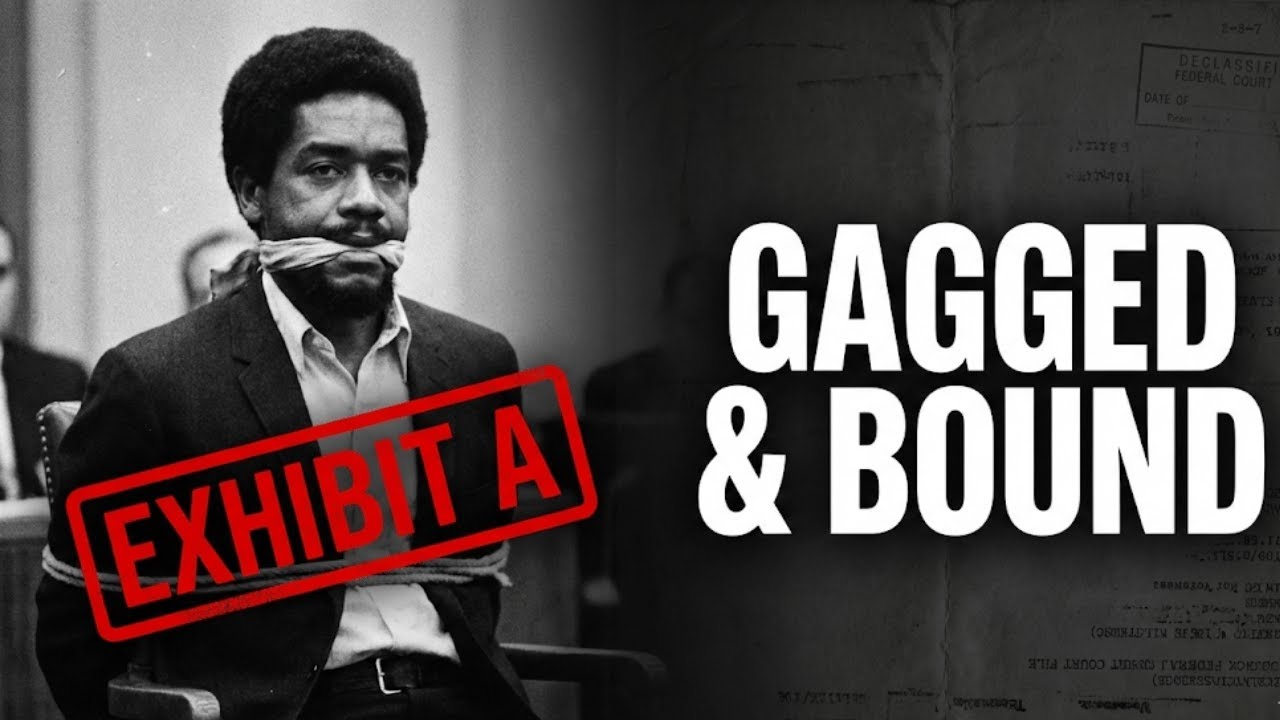
When Seale attempted to question the adequacy of his legal representation, he was met with contempt charges. When he continued to assert that his constitutional rights were being violated, Judge Hoffman escalated. On October 29, 1969, Hoffman ordered United States Marshals to physically restrain Bobby Seale during trial proceedings. Seale was bound to a chair, chains placed around his limbs, a gag forced into his mouth—silencing him, literally, before judge, jury, and press. He remained bound and gagged for subsequent court sessions while the trial continued around him.
The image was searing: a young Black man, chairman of an armed self-defense organization, restrained like an animal in a chamber of American justice. The chains and gag became the visual embodiment of the system's true logic. Law and order was not blind justice—it was state violence against those who dared to speak. The Constitution that supposedly protected Seale had been suspended, on camera, in public. The judge who ordered this violence faced no consequences, no investigation, no charge of judicial misconduct.
On November 5, 1969, Judge Hoffman severed Seale's case from the trial, making them the Chicago Six going forward. Seale was sentenced to four years in prison for contempt of court—additional time added to his punishment for refusing to be silent. The charges against him were eventually dropped, but the damage was irreversible. Seale had been publicly humiliated in the nation's courts, his body treated as something to be controlled through chains, his mouth something to be sealed with cloth.
The trial of the remaining defendants continued for months. The eventual not-guilty verdicts for most defendants proved the charges were baseless—that the government had manufactured conspiracy where none existed. But by then, Bobby Seale had already been sacrificed. His severance from the trial was itself a statement: the system could not afford to let a Black Panther share the courtroom with white radicals. Seale had to be isolated, removed, silenced. The chains and gag were the mechanism of that separation.
The Broader Struggle
This story did not unfold in isolation. It was part of a vast, interconnected struggle for equality that defined twentieth-century America. From the courtrooms to the streets, from the churches to the legislative chambers, Black Americans and their allies were challenging a system of racial oppression that had been embedded in law, custom, and daily life for centuries. Each individual story — each act of courage, each confrontation with power — was a thread in a larger tapestry of resistance.
What distinguished this era was the systematic nature of both the oppression and the resistance. The movement operated on multiple fronts simultaneously: legal challenges through organizations like the NAACP Legal Defense Fund, economic pressure through boycotts and selective buying campaigns, moral persuasion through nonviolent direct action, and cultural transformation through art, music, and literature that reframed the narrative of Black life in America.
Justice Deferred
The legal dimensions of this case reveal how the American justice system has historically functioned as both a tool of liberation and a mechanism of oppression. Courts that were capable of landmark civil rights decisions were equally capable of producing outcomes that reinforced racial hierarchies. The same Constitution that guaranteed equal protection under the law was interpreted, for generations, to permit systematic racial discrimination.
What the legal record shows is that justice, when it came at all, came slowly and incompletely. Cases dragged on for years. Evidence was suppressed, witnesses were intimidated, and juries were selected from pools that excluded Black citizens. The system worked exactly as it was designed to work — not to deliver impartial justice, but to maintain the existing social order. When that order was finally challenged, the system resisted with every tool at its disposal.
Why This Matters Now
This history is not merely an account of past events. It is a living document that shapes the present. The institutions that enabled these abuses — the FBI, local police departments, the courts — continue to operate today. The patterns of surveillance, suppression, and selective justice that defined the treatment of Black Americans in the twentieth century did not end with the passage of civil rights legislation. They evolved, adapted, and persisted in forms that are sometimes more subtle but no less consequential.
Understanding this history is essential not as an exercise in guilt or recrimination, but as a foundation for honest engagement with the ongoing challenges of racial justice in America. The stories of individuals who faced overwhelming institutional power and refused to surrender — who insisted on their dignity, their rights, and their humanity in the face of systematic attempts to deny all three — remain relevant because the struggle they waged is not over.
Leave a Reply