Harry Anslinger Used the Federal Bureau of Narcotics to Silence Billie Holiday for Singing "Strange Fruit"
In 1939, Billie Holiday performed \u201cStrange Fruit\u201d at Cafe Society in New York City. The song described lynching — Black bodies hanging from Southern trees. It was the first significant protest song to reach a mainstream American audience. Time magazine would later call it \u201cthe song of the century.\u201d
Harry Anslinger, the commissioner of the Federal Bureau of Narcotics, wanted her to stop singing it.
Anslinger ran the FBN from 1930 to 1962 — thirty-two years. He had built his career on the criminalization of marijuana, using explicitly racist propaganda to justify federal drug policy. He was, by documented record, a white supremacist who kept a file he called \u201cMarijuana and Musicians\u201d targeting Black jazz artists. Holiday was at the top of the list.
According to FBN records and accounts corroborated by multiple sources, Anslinger directly communicated to Holiday that she should stop performing \u201cStrange Fruit.\u201d She refused. The song was not illegal. He could not arrest her for singing it. So he found another way.
Holiday was a heroin user — a fact she did not hide. Anslinger sent undercover FBN agent Jimmy Fletcher to infiltrate her inner circle. Fletcher, a Black agent, befriended Holiday over months. He gained her trust. Then he arrested her.
On May 27, 1947, Holiday was arrested for narcotics possession. She waived her right to a trial, pleaded guilty, and was sentenced to one year and one day at the Federal Reformatory for Women in Alderson, West Virginia. Upon her release in 1948, the City of New York revoked her cabaret card — the license required to perform in any venue that served alcohol. Without a cabaret card, Holiday could not perform in any nightclub in New York City, the center of the jazz world.
The cabaret card revocation was the mechanism of economic destruction — identical in function to Paul Robeson's passport revocation. Holiday could still record, but live performance was her primary income and her artistic medium. Stripping the card did not end her career, but it constricted it to concert halls and out-of-town venues, reducing her income and her visibility.
Holiday continued to perform \u201cStrange Fruit\u201d everywhere she could. She never stopped.
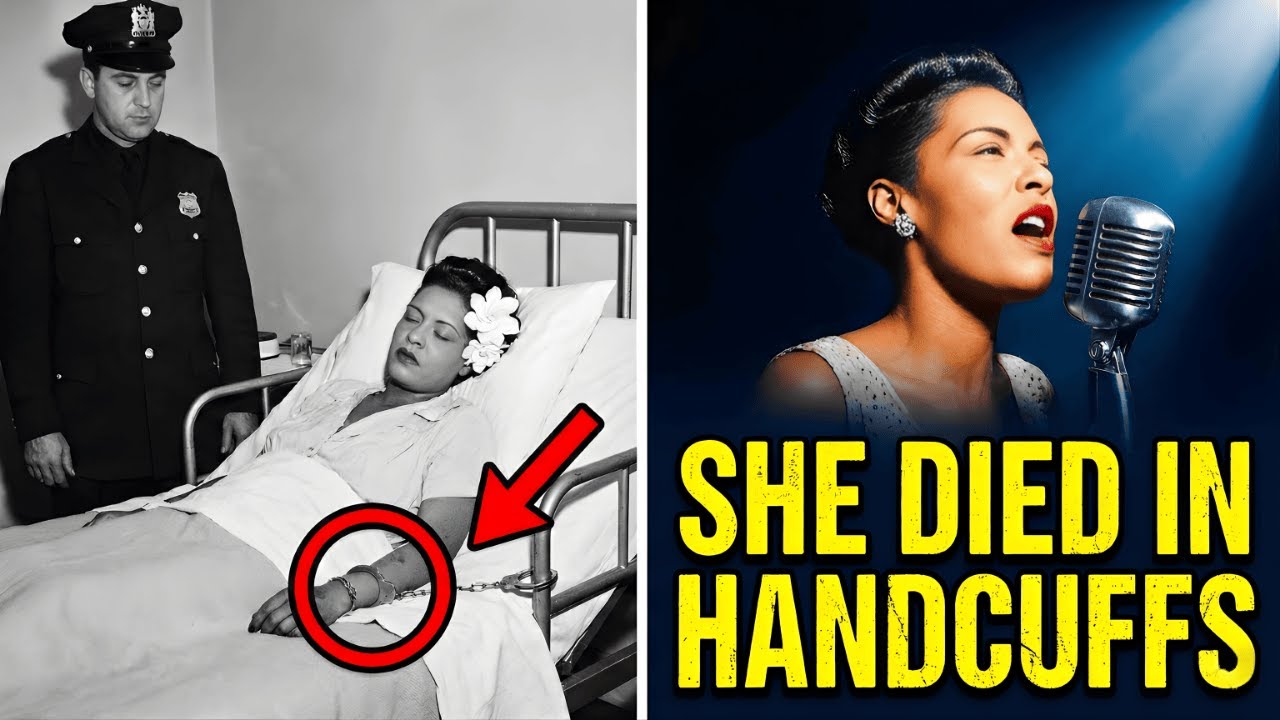
On May 31, 1959, Holiday was admitted to Metropolitan Hospital in New York with liver and heart disease. On June 12, NYPD officers arrested her in her hospital bed for narcotics possession — a small quantity of heroin was allegedly found in her room. Her flowers were removed. A police guard was posted at her door. She was fingerprinted and photographed in her bed.
Billie Holiday died on July 17, 1959. She was forty-four years old. She had $0.70 in the bank and a $750 fine taped to her hospital gown.
Harry Anslinger served as FBN commissioner for three more years after Holiday's death. The FBN's targeting of Black jazz musicians — including Charlie Parker, Thelonious Monk, and others — continued throughout his tenure. The pattern was consistent: use drug enforcement as a mechanism to control, punish, and silence Black artists who challenged the social order.
Holiday sang about lynching. Anslinger could not arrest her for the song. So he arrested her for the drugs and took away her right to perform. She sang it anyway, until the day she couldn't sing anymore. They handcuffed her to a hospital bed. She was still Billie Holiday.
The Surveillance State
The FBI’s interest was not coincidental. Under J. Edgar Hoover’s directorship, the Bureau maintained extensive surveillance programs targeting Black leaders, organizations, and cultural figures who challenged the racial status quo. COINTELPRO — the Counter Intelligence Program — was the formal structure, but the surveillance extended well beyond any single program. Field offices across the country maintained files, cultivated informants, and deployed agents to monitor, disrupt, and discredit individuals the Bureau deemed threatening to domestic order.
The methods were systematic: wiretaps, mail interception, infiltration of organizations, anonymous letters designed to destroy relationships and reputations, and coordination with local law enforcement to harass targets through arrests, tax audits, and public smear campaigns. The goal was not simply intelligence gathering — it was neutralization. The Bureau sought to prevent the rise of what internal memos described as a “Black messiah” who could unify and electrify the masses.
The Broader Struggle
This story did not unfold in isolation. It was part of a vast, interconnected struggle for equality that defined twentieth-century America. From the courtrooms to the streets, from the churches to the legislative chambers, Black Americans and their allies were challenging a system of racial oppression that had been embedded in law, custom, and daily life for centuries. Each individual story — each act of courage, each confrontation with power — was a thread in a larger tapestry of resistance.
What distinguished this era was the systematic nature of both the oppression and the resistance. The movement operated on multiple fronts simultaneously: legal challenges through organizations like the NAACP Legal Defense Fund, economic pressure through boycotts and selective buying campaigns, moral persuasion through nonviolent direct action, and cultural transformation through art, music, and literature that reframed the narrative of Black life in America.
Art as Resistance
Music was never just entertainment in this context — it was a weapon, a shield, and a declaration. Black artists who used their platform to address racial injustice understood that their art reached audiences that political speeches could not. A song could cross racial lines, enter homes through radio waves, and plant ideas in minds that might otherwise remain closed. The government understood this too, which is precisely why artists who spoke out became targets.
The relationship between Black music and political power has always been fraught. Record labels, concert promoters, and radio stations — overwhelmingly white-owned — controlled distribution and access. Artists who pushed too far politically risked losing airplay, bookings, and contracts. The choice between commercial success and authentic expression was rarely simple, and those who chose to speak truth through their art often paid a steep professional and personal price.
Justice Deferred
The legal dimensions of this case reveal how the American justice system has historically functioned as both a tool of liberation and a mechanism of oppression. Courts that were capable of landmark civil rights decisions were equally capable of producing outcomes that reinforced racial hierarchies. The same Constitution that guaranteed equal protection under the law was interpreted, for generations, to permit systematic racial discrimination.
What the legal record shows is that justice, when it came at all, came slowly and incompletely. Cases dragged on for years. Evidence was suppressed, witnesses were intimidated, and juries were selected from pools that excluded Black citizens. The system worked exactly as it was designed to work — not to deliver impartial justice, but to maintain the existing social order. When that order was finally challenged, the system resisted with every tool at its disposal.
America’s Pattern of Exile
The forced departure of Black leaders, artists, and intellectuals from the United States represents one of the country’s most damaging patterns of self-inflicted cultural and intellectual loss. Throughout the twentieth century, America systematically drove away some of its most brilliant citizens — not through formal banishment, but through a campaign of harassment, economic pressure, and legal persecution that made remaining in the country untenable.
The list of Black Americans who lived in exile — voluntarily or otherwise — reads like a catalog of American genius. Writers, musicians, scientists, and activists found in Paris, London, Accra, and Havana the freedom to live and work without the constant threat of racial violence and government surveillance. Their departure impoverished American culture while enriching the nations that received them.
Why This Matters Now
This history is not merely an account of past events. It is a living document that shapes the present. The institutions that enabled these abuses — the FBI, local police departments, the courts — continue to operate today. The patterns of surveillance, suppression, and selective justice that defined the treatment of Black Americans in the twentieth century did not end with the passage of civil rights legislation. They evolved, adapted, and persisted in forms that are sometimes more subtle but no less consequential.
Understanding this history is essential not as an exercise in guilt or recrimination, but as a foundation for honest engagement with the ongoing challenges of racial justice in America. The stories of individuals who faced overwhelming institutional power and refused to surrender — who insisted on their dignity, their rights, and their humanity in the face of systematic attempts to deny all three — remain relevant because the struggle they waged is not over.
Leave a Reply