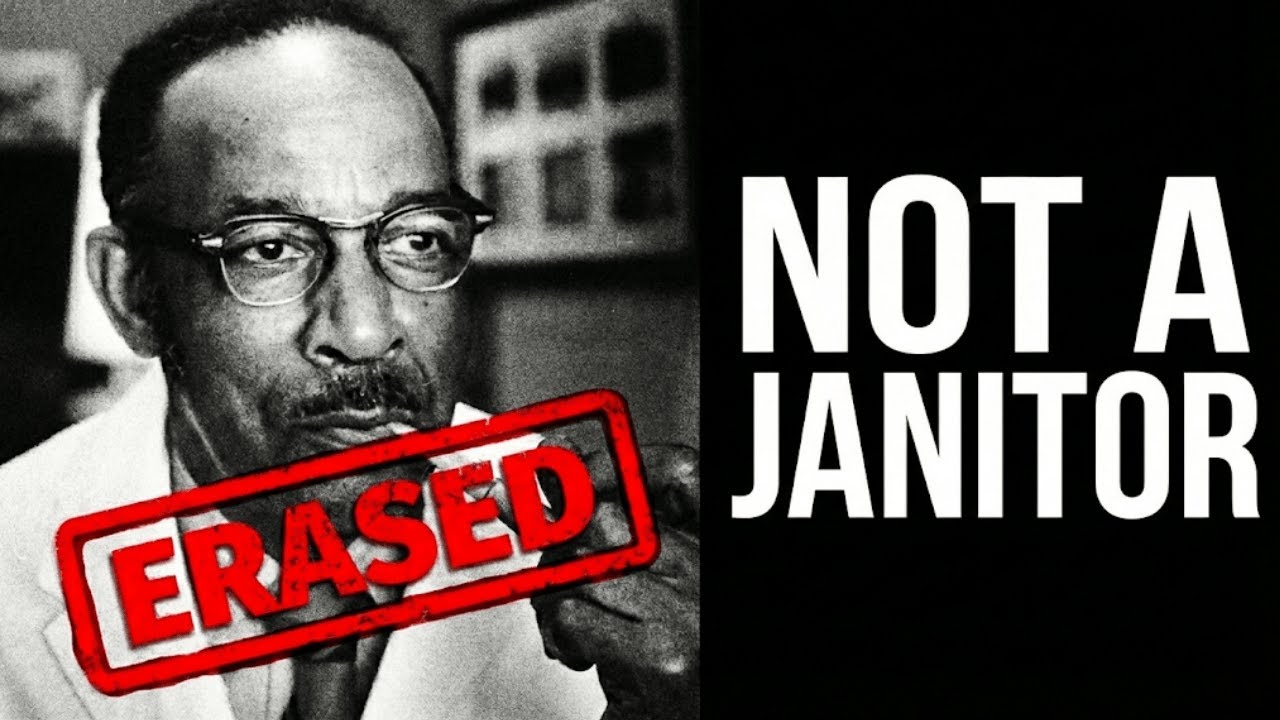
Vivien Thomas: The Janitor Who Revolutionized Heart Surgery
Vivien Thomas developed a surgical technique that saved thousands of children's lives. He had no medical degree. His official job classification was janitor. His salary was less than half of what a white surgeon earned. No medical school would admit him. He changed medicine anyway.
Thomas was born in Nashville, Tennessee in 1910. He was intelligent, ambitious, and dreamed of attending medical school. In 1929, after high school, he worked to save money for college. Then the stock market crashed. His savings—nearly $5,000, which would have been enough for several years of education—evaporated. Medical school became impossible. Instead, at age 19, Thomas took a job as a laboratory assistant at Vanderbilt University's School of Medicine, working for Dr. Alfred Blalock. He expected the job to be temporary. He worked there for seventeen years.
What happened during those seventeen years was that Vivien Thomas became a surgical genius. Blalock recognized immediately that Thomas possessed an intuitive understanding of surgical technique. Thomas was given increasing responsibility—he began conducting research, designing experiments, developing surgical procedures. He had no formal training, no credentials, no institutional authority. But he had precision, intelligence, and an almost instinctive understanding of how to approach surgical problems. When Blalock moved to Johns Hopkins Hospital in Baltimore in 1941, he brought Thomas with him. Johns Hopkins had no job category for a Black surgical researcher, so Thomas was classified as a janitor. His salary was less than a white orderly earned.
At Johns Hopkins, Thomas and Blalock worked together on a problem that had stumped cardiac surgeons: blue baby syndrome, a congenital heart defect in which infants were born with inadequate oxygen circulation and often died in infancy. The solution required developing a new surgical approach—essentially creating an alternative pathway for blood flow around the defective heart structure. For months, Thomas worked in the laboratory, experimenting with different surgical techniques, testing them, refining the procedure. He developed what would become known as the Blalock-Thomas-Taussig shunt—a procedure that allowed blood to bypass the defective heart chamber and reach the lungs for oxygen absorption. Thomas essentially invented the procedure.
In November 1944, the procedure was performed on its first human patient—an 18-month-old girl named Eileen Saxon. Blalock performed the surgery, but Thomas had developed it, tested it, and coached Blalock through the operation. The surgery was successful. Eileen Saxon survived and thrived. Word spread through the medical community: there was a surgical solution to blue baby syndrome. Hundreds, then thousands of children who would have died now survived.
Blalock received the credit. Medical journals published his name. Universities invited him to give lectures about the revolutionary procedure. He received international acclaim, prestigious appointments, and professional honors. Thomas received acknowledgment in some medical papers—often as a secondary contributor, sometimes not mentioned at all. He remained classified as a janitor, earning a janitorial salary for conducting world-changing medical research. When colleagues realized that Thomas had developed the procedure, some objected to his presence in the operating room—not because his work was inadequate but because his presence violated racial hierarchies.
For thirty-two years, Vivien Thomas remained in this position—the unacknowledged creator of one of cardiac surgery's foundational techniques. In 1976, Johns Hopkins granted him an honorary doctorate, finally providing institutional recognition. He died in 1985. By then, the procedure was renamed the Blalock-Thomas-Taussig shunt, finally including his name. But the deeper erasure—the systemic exclusion that prevented him from becoming what he should have been, a celebrated cardiac surgeon—had already been accomplished. The medical system had extracted his genius, credited it to others, and paid him a janitor's wage.
The Broader Struggle
This story did not unfold in isolation. It was part of a vast, interconnected struggle for equality that defined twentieth-century America. From the courtrooms to the streets, from the churches to the legislative chambers, Black Americans and their allies were challenging a system of racial oppression that had been embedded in law, custom, and daily life for centuries. Each individual story — each act of courage, each confrontation with power — was a thread in a larger tapestry of resistance.
What distinguished this era was the systematic nature of both the oppression and the resistance. The movement operated on multiple fronts simultaneously: legal challenges through organizations like the NAACP Legal Defense Fund, economic pressure through boycotts and selective buying campaigns, moral persuasion through nonviolent direct action, and cultural transformation through art, music, and literature that reframed the narrative of Black life in America.
The Price of Resistance
The violence that punctuated the struggle for Black equality was not random. It was strategic, designed to terrorize communities into submission and to send a message to anyone who might consider challenging the racial order. Every killing, every beating, every act of destruction served a purpose within a system that depended on Black acquiescence for its survival.
What the perpetrators consistently underestimated was the resilience of the communities they targeted. Violence did not silence the movement — it amplified it. Each act of brutality created new activists, new allies, and new urgency. The photographs, the testimonies, and the names of the fallen became rallying points that sustained the struggle across generations.
Why This Matters Now
This history is not merely an account of past events. It is a living document that shapes the present. The institutions that enabled these abuses — the FBI, local police departments, the courts — continue to operate today. The patterns of surveillance, suppression, and selective justice that defined the treatment of Black Americans in the twentieth century did not end with the passage of civil rights legislation. They evolved, adapted, and persisted in forms that are sometimes more subtle but no less consequential.
Understanding this history is essential not as an exercise in guilt or recrimination, but as a foundation for honest engagement with the ongoing challenges of racial justice in America. The stories of individuals who faced overwhelming institutional power and refused to surrender — who insisted on their dignity, their rights, and their humanity in the face of systematic attempts to deny all three — remain relevant because the struggle they waged is not over.
Leave a Reply