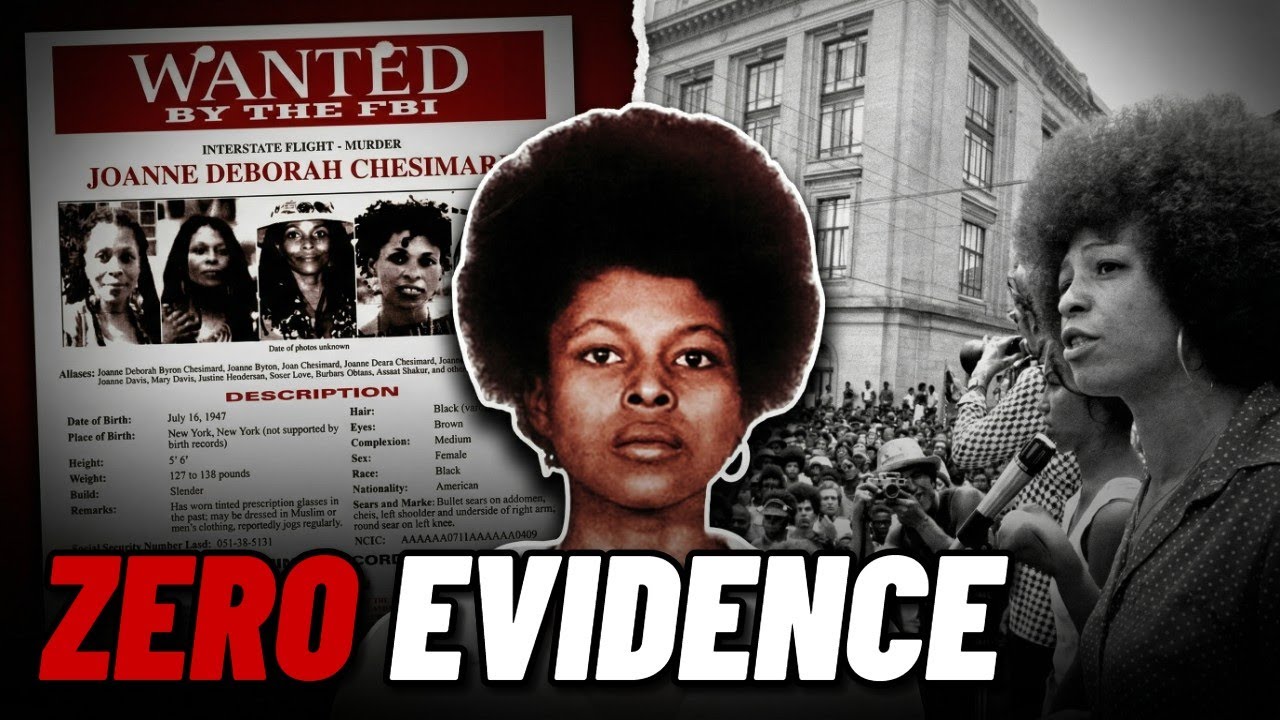
The FBI Created an Operation Named After Her
Before Assata Shakur ever stood trial for the New Jersey Turnpike shooting, the FBI had already built an entire operation around her. CHESROB — named after her legal name, Chesimard — was designed to link her to virtually every crime committed by a Black woman on the East Coast. Ten indictments followed. Seven trials. Three acquittals. Three dismissals. One hung jury. One mistrial. The only conviction that stuck came from the one case where the forensic evidence said she couldn’t have done it.
May 2, 1973 — The New Jersey Turnpike
On a stretch of the New Jersey Turnpike, state troopers pulled over a vehicle carrying Assata Shakur, Zayd Malik Shakur, and Sundiata Acoli. What happened next became one of the most contested crime scenes in American legal history. Trooper Werner Foerster was killed. Zayd Shakur was killed. Assata was shot twice — once in the back, once through the clavicle — and survived. The prosecution would later argue she fired the fatal shots. The forensic evidence told a different story entirely.
The Forensic Evidence Nobody Talks About
The New Jersey Crime Lab and the FBI Crime Labs in Washington both ran tests on Assata’s hands. Neutron activation analysis — the most sensitive gunshot residue test available in 1973 — found nothing. No fingerprints on any weapon at the scene matched hers. The prosecution’s own evidence couldn’t place a gun in her hands at any point during the encounter.
Doctor Davidson: “Anatomically Impossible”
Neurosurgeon Dr. Arthur Turner Davidson of Albert Einstein College of Medicine examined Assata’s wounds and testified it was “anatomically impossible” for her to have raised a weapon given the trajectory of the bullet through her clavicle. Pathologist Dr. David Spain of Brookdale Community College corroborated: “No conceivable way.” The defense presented medical testimony that should have ended the case. It didn’t.
Trooper Harper Admits He Lied Under Oath
The prosecution’s star witness, Trooper James Harper, was the only law enforcement officer who claimed to have seen Assata fire a weapon. Under cross-examination, Harper admitted he had lied in all three of his official reports about the incident — and in his grand jury testimony. His account of the shooting changed with each telling. The jury heard this admission. They convicted her anyway.
The Jury Was Stacked From the Start
The trial was moved to an all-white jurisdiction. Judge Theodore Appleby issued a jury instruction that would define the case: Assata’s “mere presence” at the scene was sufficient to establish guilt — even without proof she fired a weapon. The instruction effectively removed the burden of proving she pulled the trigger. On March 25, 1977, the jury returned a guilty verdict.
CHESROB: 10 Indictments, 1 Conviction
Across every other case the FBI brought against Assata Shakur, the pattern was the same: charge, try, fail. Bank robberies she was nowhere near. Kidnapping charges that collapsed. Murder charges with no evidence. The CHESROB operation generated headlines and indictments but could not produce convictions — except in the one case where the forensic record contradicted every element of the prosecution’s theory.
Escape, Cuba, and the $2 Million Bounty
In 1979, members of the Black Liberation Army broke Assata out of the Clinton Correctional Facility for Women. She surfaced in Cuba in 1984, where Fidel Castro granted her political asylum. The FBI placed her on its Most Wanted Terrorists list in 2013 — the first woman ever added — with a $2 million bounty. She lived in Havana until her death on September 25, 2025, at the age of seventy-eight.
The Conviction Has Never Been Overturned
The forensic evidence remains in the court record. The neutron activation analysis. The fingerprint reports. Dr. Davidson’s testimony. Trooper Harper’s admitted perjury. Judge Appleby’s “mere presence” instruction. None of it has been revisited. The conviction stands. The FBI never removed her from its Most Wanted Terrorists list.
Leave a Reply