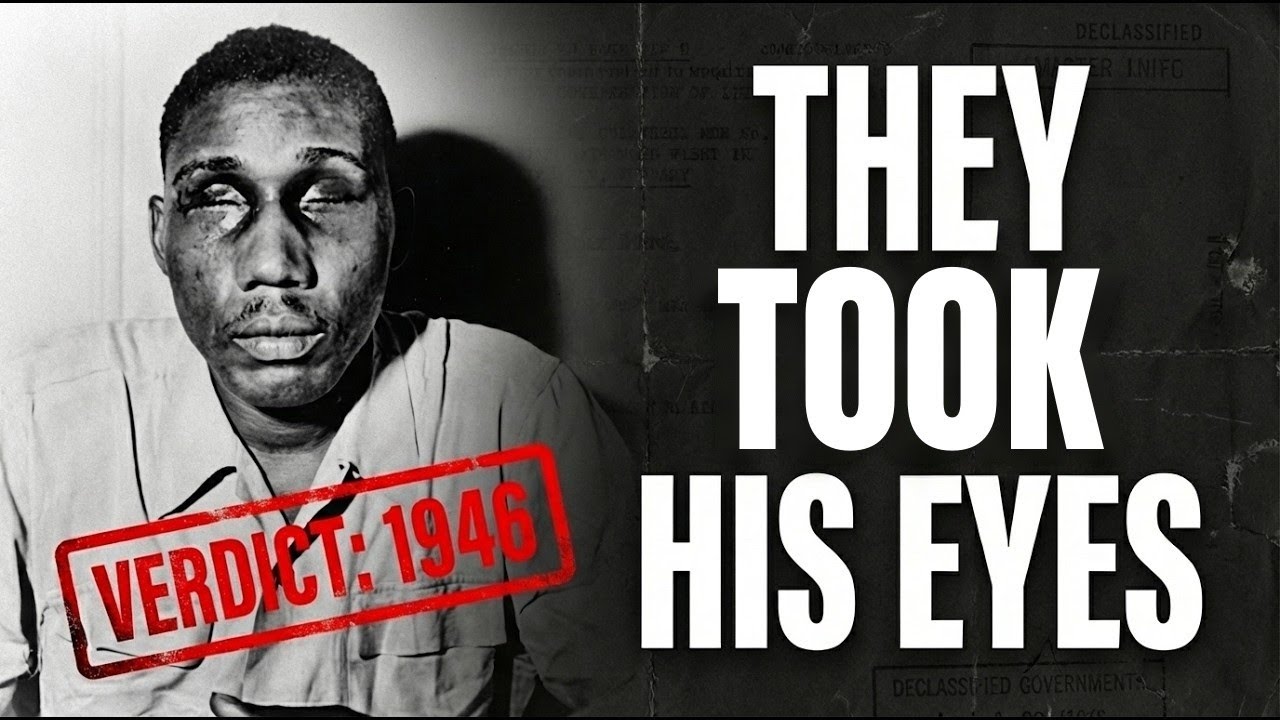
On November 5, 1946, a police chief walked into a federal courtroom in Columbia, South Carolina, sat down on the witness stand, and admitted that he had beaten a decorated soldier in both eyes with a blackjack. He said it on the record, under oath, in front of a judge. The jury took thirty minutes. They let him go. And the courtroom broke into applause.
That’s not the worst part. The worst part is what the system did before, during, and after that trial to make sure the man who confessed would walk free. Because this was not a failure of justice. This was justice working exactly the way it was built to work.
The Greyhound Bus
The soldier’s name was Isaac Woodard. He was twenty-six years old. He had spent three and a half years in the Army. He earned a battle star for unloading ships under enemy fire in New Guinea. He received an honorable discharge from Camp Gordon, Georgia, on February 12, 1946. He was still in uniform when they took his eyes. He had been a civilian for less than a day.
It started on a Greyhound bus. Woodard asked the driver, a man named Alton Blackwell, if he could use the restroom at a stop outside Augusta. Blackwell cursed at him. Woodard said, “Talk to me like I’m talking to you. I’m a man just like you.” That was it. That was the crime. A Black sergeant had told a white bus driver to speak to him like a human being.
When the bus pulled into Batesburg, South Carolina, Blackwell stepped off and found the town’s police chief, Lynwood Shull, sitting in the patrol car. He told Shull a soldier had been “making a disturbance.” He did not mention the disturbance was a bathroom request.
The Blinding
Shull was forty years old, five foot nine, and well over two hundred pounds. He had been Batesburg’s police chief for eight years. He carried a blackjack — a leather weapon with a spring-loaded handle and steel shot packed in the tip. His police uniform had a pocket sewn into the pants leg just to hold it.
Shull dragged Woodard into an alleyway out of sight of the bus. He hit him across the head, then marched him toward the town jail. On the walk, Shull asked if Woodard had been discharged. Woodard answered yes. Shull cracked him again and told him the correct answer was “yes, sir.” Woodard grabbed the blackjack out of Shull’s hand. The other officer pulled his revolver. Woodard dropped the weapon. Shull picked it back up and beat him unconscious.
When Woodard came to on the ground, Shull drove the end of the blackjack into each of his eyes. Over and over. He hit him so hard the weapon broke. Isaac Woodard was left permanently, totally blind.
The next morning, they dragged him in front of a local judge — bleeding, blinded, with partial amnesia. The judge convicted him of drunk and disorderly conduct and fined him fifty dollars. No evidence of drinking. No lawyer. No doctor. It took two more days before anyone gave him medical attention. His family didn’t know where he was for three weeks.
Orson Welles and Officer X
That should have been the end of the story. Blinded soldier buried in a VA hospital, no benefits, no press, no name. But the NAACP got the case. Their executive secretary, Walter White, reached out to the biggest name in American broadcasting — Orson Welles.
On July 28, 1946, Welles read Woodard’s sworn affidavit on national radio. He didn’t know who the officer was. Nobody did. So he called him “Officer X” and made a promise on the air: he would find him. For five straight weeks, Welles hammered the story. He hired private investigators and dug through police records.
Then a soldier who had been on the bus wrote to the NAACP. He’d heard the broadcast. He said it was Batesburg. Within days, they had Shull’s name. Welles went back on the air: “Officer X, we know your name now. You cannot get rid of me.”
Twenty thousand people showed up to a benefit concert at Lewisohn Stadium in New York. Joe Louis hosted. Billie Holiday performed. Woody Guthrie wrote a song called “The Blinding of Isaac Woodard” and sang it that night. Woodard stood on that stage, blind, in sunglasses, and told the crowd: “I spent three and a half years in the service of my country and thought I would be treated like a man when I returned to civilian life. But I was mistaken.”
The Trial
On September 19, 1946, Walter White sat across from President Harry Truman at the White House and described what had happened to Isaac Woodard. According to multiple accounts, Truman was visibly shaken. He ordered the Justice Department to prosecute Shull under federal civil rights statutes — the only legal avenue available, since South Carolina would never prosecute its own police chief.
The trial took place on November 5, 1946, in Columbia, South Carolina, before an all-white jury. Federal Judge J. Waties Waring presided. The prosecution’s case was straightforward: Shull had admitted the beating. He testified on the stand that he had struck Woodard with the blackjack. The defense’s strategy was equally straightforward: Woodard was a drunk Black soldier who had it coming.
The jury deliberated for thirty minutes. Not guilty. The courtroom erupted in applause. Shull walked out a free man. He returned to Batesburg and remained police chief.
What Came After
Judge Waring, who had watched the acquittal from the bench, was transformed by what he witnessed. A seventh-generation white South Carolinian from the planter class, Waring had never questioned Jim Crow before presiding over the Woodard case. The jury’s celebration of Shull’s acquittal radicalized him. Over the next four years, Waring issued a series of rulings that dismantled South Carolina’s white primary system and challenged segregation in public education — rulings that laid groundwork for Brown v. Board of Education.
Truman, equally affected, issued Executive Order 9981 on July 26, 1948, desegregating the United States Armed Forces. Multiple historians have drawn a direct line from the Woodard case to that order. A Black soldier blinded in uniform became one of the catalysts for ending military segregation.
Isaac Woodard lived until 1992. He spent forty-six years in darkness. Lynwood Shull died in 1997, never having faced any consequence for what he did in that alleyway in Batesburg. The system that blinded Woodard and freed his attacker worked exactly as it was designed. The people who changed it — Welles, White, Waring, Truman — did so not because the system corrected itself, but because individuals chose to break it.
Leave a Reply