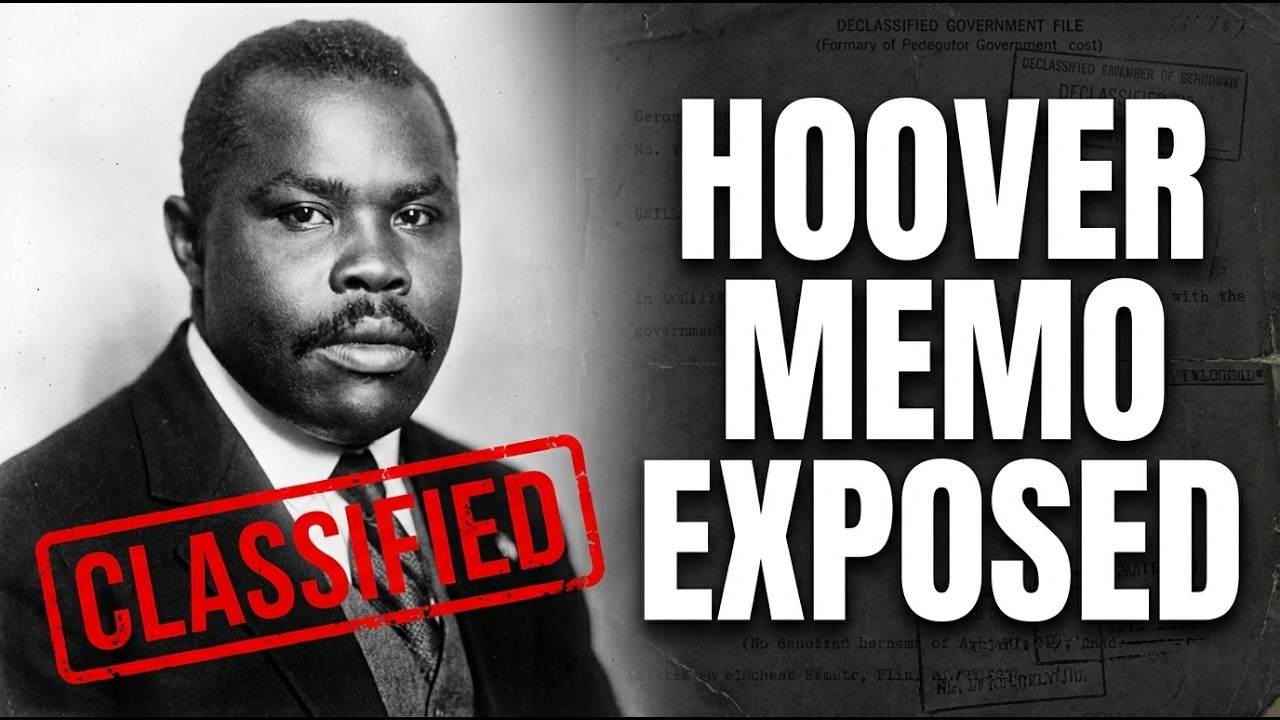
The Shocking 1919 Memo That Ended America's Largest Black Movement
Marcus Garvey's Universal Negro Improvement Association (UNIA) became the largest Black nationalist movement in American history, reaching peak membership of between 4 and 6 million people by 1920. Garvey's Black Star Line—a shipping company designed to facilitate trade between Black communities across the diaspora—represented the most audacious attempt at Black economic independence in the modern era. By 1919, Garvey had become the most powerful Black leader in America, commanding greater organizational reach than any predecessor. The establishment recognized him as an existential threat.
J. Edgar Hoover, newly appointed director of the Bureau of Investigation's Radical Division, personally composed a memo on August 1, 1919, recommending Garvey's prosecution. The memo is a document of staggering candor. Hoover explicitly acknowledged that Garvey had committed no federal crime. Yet he recommended prosecuting him anyway. The evidence Hoover pointed to was a single empty envelope—alleged to have contained revolutionary materials, though nothing was ever found. Hoover's logic was naked: Garvey's propaganda made him dangerous, and therefore he must be prosecuted.
This memo established a template that would define the FBI's operations for decades. It revealed the true nature of the bureau's mission: not law enforcement based on criminal conduct, but political suppression based on ideological threat. Hoover didn't need to prove a crime. He needed only to declare a person dangerous and then manufacture the justification.
The government pursued mail fraud charges, claiming Garvey had misrepresented the Black Star Line's financial status in promotional materials. The trial was a spectacle of predetermined outcome. Garvey was convicted in June 1923, sentenced to five years, and imprisoned at the Atlanta Federal Penitentiary. On December 2, 1927, he was deported to Jamaica—not for defrauding investors, but for threatening Black independence.
Garvey died in London in 1940, having lost everything the American government had destroyed. The UNIA, which once filled Madison Square Garden with thousands of Black nationalists, was dismantled. The Black Star Line, which represented the tangible infrastructure of Black economic autonomy, was seized. Yet Garvey's conviction was later recognized as politically motivated—a belated acknowledgment that the prosecution was political theater. By then, the damage was irreversible.
Hoover's success against Garvey taught the FBI a crucial lesson: you do not need evidence. You need only power, patience, and the willingness to manufacture a crime.
The Surveillance State
The FBI’s interest was not coincidental. Under J. Edgar Hoover’s directorship, the Bureau maintained extensive surveillance programs targeting Black leaders, organizations, and cultural figures who challenged the racial status quo. COINTELPRO — the Counter Intelligence Program — was the formal structure, but the surveillance extended well beyond any single program. Field offices across the country maintained files, cultivated informants, and deployed agents to monitor, disrupt, and discredit individuals the Bureau deemed threatening to domestic order.
The methods were systematic: wiretaps, mail interception, infiltration of organizations, anonymous letters designed to destroy relationships and reputations, and coordination with local law enforcement to harass targets through arrests, tax audits, and public smear campaigns. The goal was not simply intelligence gathering — it was neutralization. The Bureau sought to prevent the rise of what internal memos described as a “Black messiah” who could unify and electrify the masses.
The Broader Struggle
This story did not unfold in isolation. It was part of a vast, interconnected struggle for equality that defined twentieth-century America. From the courtrooms to the streets, from the churches to the legislative chambers, Black Americans and their allies were challenging a system of racial oppression that had been embedded in law, custom, and daily life for centuries. Each individual story — each act of courage, each confrontation with power — was a thread in a larger tapestry of resistance.
What distinguished this era was the systematic nature of both the oppression and the resistance. The movement operated on multiple fronts simultaneously: legal challenges through organizations like the NAACP Legal Defense Fund, economic pressure through boycotts and selective buying campaigns, moral persuasion through nonviolent direct action, and cultural transformation through art, music, and literature that reframed the narrative of Black life in America.
Justice Deferred
The legal dimensions of this case reveal how the American justice system has historically functioned as both a tool of liberation and a mechanism of oppression. Courts that were capable of landmark civil rights decisions were equally capable of producing outcomes that reinforced racial hierarchies. The same Constitution that guaranteed equal protection under the law was interpreted, for generations, to permit systematic racial discrimination.
What the legal record shows is that justice, when it came at all, came slowly and incompletely. Cases dragged on for years. Evidence was suppressed, witnesses were intimidated, and juries were selected from pools that excluded Black citizens. The system worked exactly as it was designed to work — not to deliver impartial justice, but to maintain the existing social order. When that order was finally challenged, the system resisted with every tool at its disposal.
America’s Pattern of Exile
The forced departure of Black leaders, artists, and intellectuals from the United States represents one of the country’s most damaging patterns of self-inflicted cultural and intellectual loss. Throughout the twentieth century, America systematically drove away some of its most brilliant citizens — not through formal banishment, but through a campaign of harassment, economic pressure, and legal persecution that made remaining in the country untenable.
The list of Black Americans who lived in exile — voluntarily or otherwise — reads like a catalog of American genius. Writers, musicians, scientists, and activists found in Paris, London, Accra, and Havana the freedom to live and work without the constant threat of racial violence and government surveillance. Their departure impoverished American culture while enriching the nations that received them.
Why This Matters Now
This history is not merely an account of past events. It is a living document that shapes the present. The institutions that enabled these abuses — the FBI, local police departments, the courts — continue to operate today. The patterns of surveillance, suppression, and selective justice that defined the treatment of Black Americans in the twentieth century did not end with the passage of civil rights legislation. They evolved, adapted, and persisted in forms that are sometimes more subtle but no less consequential.
Understanding this history is essential not as an exercise in guilt or recrimination, but as a foundation for honest engagement with the ongoing challenges of racial justice in America. The stories of individuals who faced overwhelming institutional power and refused to surrender — who insisted on their dignity, their rights, and their humanity in the face of systematic attempts to deny all three — remain relevant because the struggle they waged is not over.
Leave a Reply