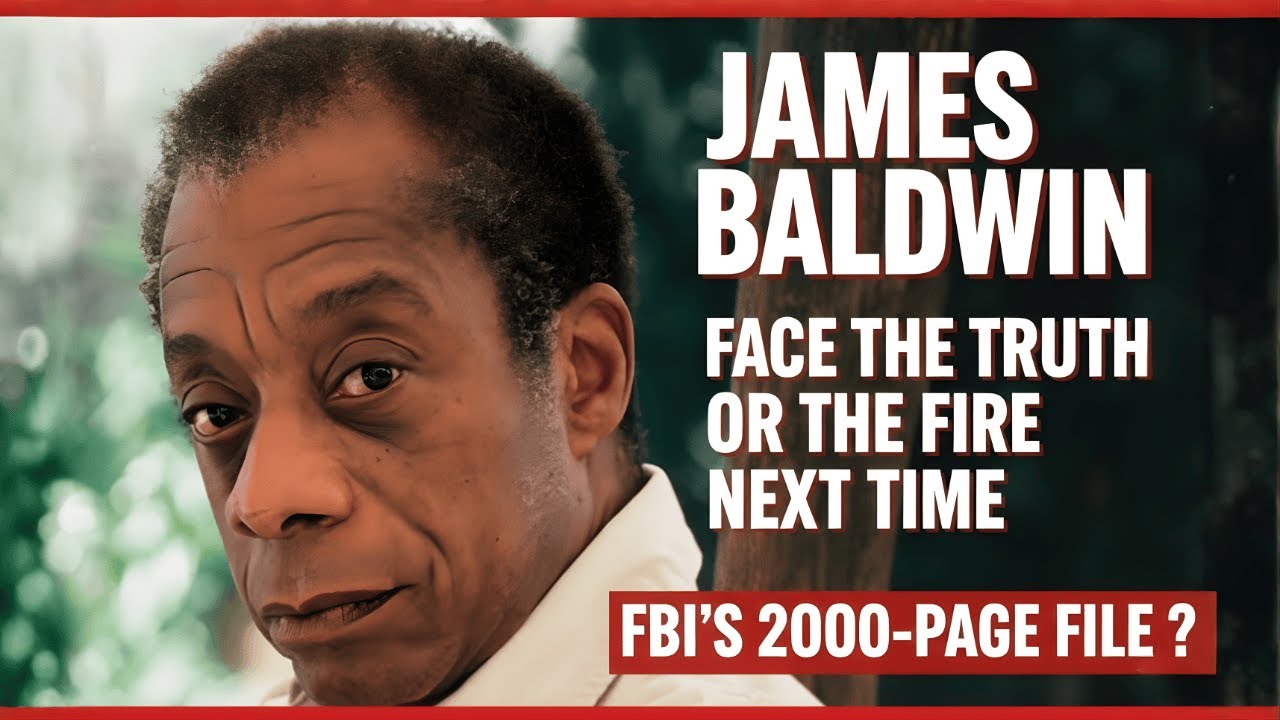
The FBI Compiled 1,884 Pages on James Baldwin for Writing About America
James Baldwin published \u201cThe Fire Next Time\u201d in 1963. The book sold over a million copies and placed Baldwin on the cover of Time magazine. It described American racism with a precision and moral clarity that no writer had achieved before — or has since. The FBI responded by expanding his surveillance file.
Bureau File #100-146553 — James Arthur Baldwin — runs to 1,884 pages. The surveillance began in 1960, three years before \u201cThe Fire Next Time,\u201d and continued until at least 1974. The FBI monitored Baldwin's writings, his speeches, his travels, his personal relationships, and his associations with civil rights leaders.
Baldwin was not an organizer. He held no position in any civil rights organization. He did not lead marches, plan demonstrations, or direct campaigns. He was a writer. The FBI surveilled him for what he wrote.
The Bureau's concern was specific. A 1964 memo from the New York field office described Baldwin as \u201ca dangerous individual who could be expected to commit acts inimical to the national defense and public safety of the United States.\u201d The memo recommended Baldwin be placed on the Security Index — a classified list of individuals to be detained in the event of a national emergency.
The evidence for this assessment: his books. His essays. His public statements about American racism. The FBI treated literary criticism of the United States as a national security threat.
Baldwin's file documents the Bureau's obsession with his sexuality. Multiple reports reference his homosexuality, treating it as both a personal vulnerability to be exploited and evidence of moral unsuitability. Agents monitored his romantic relationships and his residences in France, Turkey, and the United States. The Bureau attempted to use his sexuality to discredit him with civil rights leaders — the same strategy applied to Bayard Rustin.
In 1963, Attorney General Robert Kennedy arranged a meeting with Baldwin and other Black artists and intellectuals. The meeting was contentious — Baldwin and the other participants expressed frustration with the Kennedy administration's pace on civil rights. The FBI file on the meeting runs to dozens of pages. Agents identified every participant, documented every statement, and assessed each person's potential as a \u201cthreat.\u201d
Baldwin spent much of his later life in France, not because he was exiled but because America was, as he wrote, \u201cnot a pleasant place to be.\u201d The FBI monitored his activities abroad through legal attaches at American embassies. His file includes reports from Paris, Istanbul, and London.
The 1,884 pages contain no evidence of criminal activity. There are no allegations of violence, no connections to illegal operations, no evidence of espionage. The entire file documents one thing: a Black man who wrote with extraordinary power about the country he lived in, and a government that treated his words as weapons.
James Baldwin died on December 1, 1987, in Saint-Paul-de-Vence, France. He was sixty-three. The FBI file was partially released through FOIA in the 1990s. Scholars who have reviewed the file describe it as a document of institutional paranoia — the federal government deploying its surveillance apparatus against a novelist because his novels were too accurate.
Baldwin wrote: \u201cNot everything that is faced can be changed, but nothing can be changed until it is faced.\u201d The FBI spent twenty-four years and 1,884 pages trying to face James Baldwin. They never figured out what to do about a man whose only weapon was the truth.
The Surveillance State
The FBI’s interest was not coincidental. Under J. Edgar Hoover’s directorship, the Bureau maintained extensive surveillance programs targeting Black leaders, organizations, and cultural figures who challenged the racial status quo. COINTELPRO — the Counter Intelligence Program — was the formal structure, but the surveillance extended well beyond any single program. Field offices across the country maintained files, cultivated informants, and deployed agents to monitor, disrupt, and discredit individuals the Bureau deemed threatening to domestic order.
The methods were systematic: wiretaps, mail interception, infiltration of organizations, anonymous letters designed to destroy relationships and reputations, and coordination with local law enforcement to harass targets through arrests, tax audits, and public smear campaigns. The goal was not simply intelligence gathering — it was neutralization. The Bureau sought to prevent the rise of what internal memos described as a “Black messiah” who could unify and electrify the masses.
The Broader Struggle
This story did not unfold in isolation. It was part of a vast, interconnected struggle for equality that defined twentieth-century America. From the courtrooms to the streets, from the churches to the legislative chambers, Black Americans and their allies were challenging a system of racial oppression that had been embedded in law, custom, and daily life for centuries. Each individual story — each act of courage, each confrontation with power — was a thread in a larger tapestry of resistance.
What distinguished this era was the systematic nature of both the oppression and the resistance. The movement operated on multiple fronts simultaneously: legal challenges through organizations like the NAACP Legal Defense Fund, economic pressure through boycotts and selective buying campaigns, moral persuasion through nonviolent direct action, and cultural transformation through art, music, and literature that reframed the narrative of Black life in America.
America’s Pattern of Exile
The forced departure of Black leaders, artists, and intellectuals from the United States represents one of the country’s most damaging patterns of self-inflicted cultural and intellectual loss. Throughout the twentieth century, America systematically drove away some of its most brilliant citizens — not through formal banishment, but through a campaign of harassment, economic pressure, and legal persecution that made remaining in the country untenable.
The list of Black Americans who lived in exile — voluntarily or otherwise — reads like a catalog of American genius. Writers, musicians, scientists, and activists found in Paris, London, Accra, and Havana the freedom to live and work without the constant threat of racial violence and government surveillance. Their departure impoverished American culture while enriching the nations that received them.
Why This Matters Now
This history is not merely an account of past events. It is a living document that shapes the present. The institutions that enabled these abuses — the FBI, local police departments, the courts — continue to operate today. The patterns of surveillance, suppression, and selective justice that defined the treatment of Black Americans in the twentieth century did not end with the passage of civil rights legislation. They evolved, adapted, and persisted in forms that are sometimes more subtle but no less consequential.
Understanding this history is essential not as an exercise in guilt or recrimination, but as a foundation for honest engagement with the ongoing challenges of racial justice in America. The stories of individuals who faced overwhelming institutional power and refused to surrender — who insisted on their dignity, their rights, and their humanity in the face of systematic attempts to deny all three — remain relevant because the struggle they waged is not over.
Leave a Reply