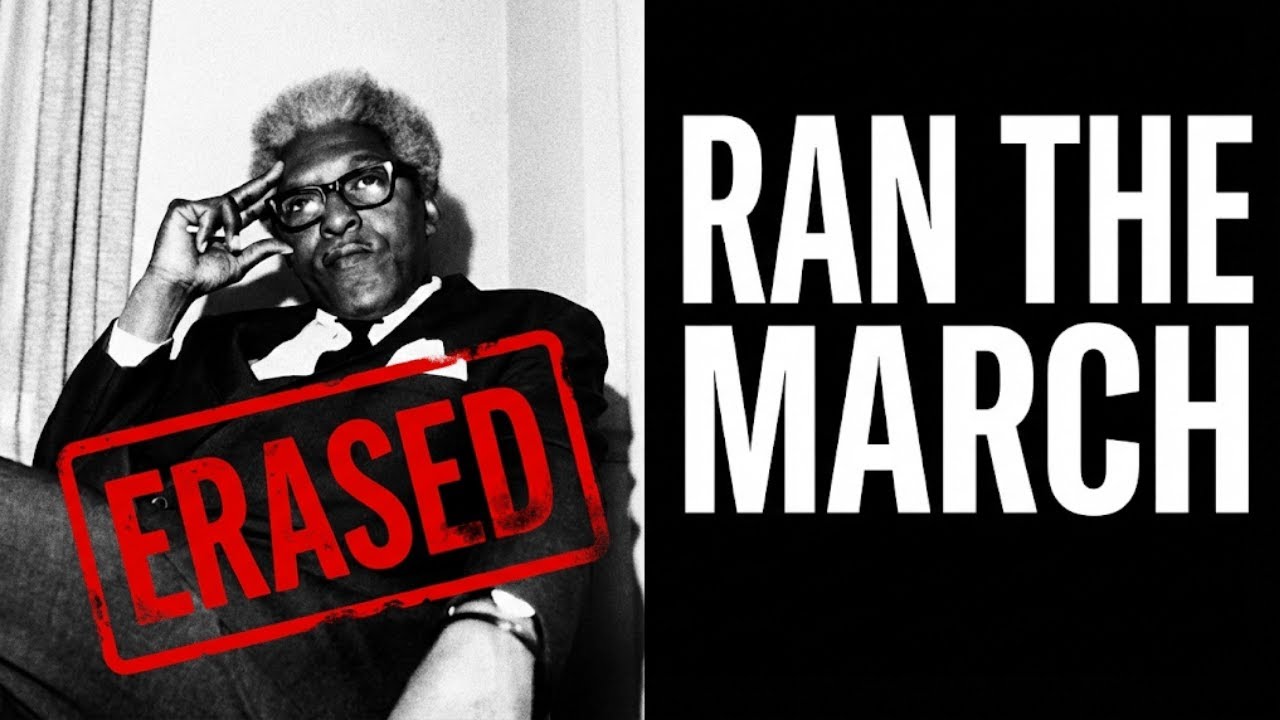
Bayard Rustin Organized the March on Washington. They Erased Him Because He Was Gay.
On August 28, 1963, approximately 250,000 people gathered at the Lincoln Memorial for the March on Washington for Jobs and Freedom. The logistics were staggering: 21 chartered trains, 30 special trains through the regular schedule, thousands of buses, over 1,500 volunteer marshals, 292 portable toilets, 40 first aid stations, and a sound system that carried speeches across the National Mall. The march was executed without a single arrest.
The person who organized all of it was Bayard Rustin. He built the entire operation in less than two months.
Rustin was arguably the most consequential organizer in the history of the American civil rights movement. He introduced Martin Luther King Jr. to Gandhian nonviolent resistance during the Montgomery Bus Boycott in 1956 — it was Rustin who traveled to Montgomery and convinced King to remove the armed guards from his home and commit fully to nonviolence. He organized the first Freedom Rides in 1947 (the Journey of Reconciliation), sixteen years before CORE's 1961 Freedom Rides. He was a founding member of the Southern Christian Leadership Conference.
The civil rights establishment kept him hidden because he was gay.
In 1953, Rustin was arrested in Pasadena, California, on a morals charge related to homosexual activity. He served sixty days in the Los Angeles County Jail. The arrest became a permanent weapon against him. Every time Rustin was proposed for a visible leadership role, opponents within and outside the movement cited the arrest.
The FBI exploited this relentlessly. Bureau File #100-158790 documents the FBI's surveillance of Rustin from the early 1950s through the 1970s. Agents monitored his personal relationships, his residences, and his sexual activity. The Bureau distributed information about Rustin's sexuality to civil rights leaders, journalists, and members of Congress with the explicit goal of undermining his influence.
In 1960, Congressman Adam Clayton Powell Jr. threatened to tell the press that Rustin and King were having a sexual affair — a fabrication — unless King cancelled a planned protest at the Democratic National Convention. King cancelled the protest and distanced himself from Rustin. The threat worked because the movement could not afford the association.
When the March on Washington was being organized, A. Philip Randolph insisted that Rustin be the lead organizer. Senator Strom Thurmond took the Senate floor and read Rustin's 1953 arrest record into the Congressional Record, calling him a \u201ccommunist, draft dodger, and homosexual.\u201d Randolph refused to remove Rustin but agreed that Randolph himself would serve as the nominal director, with Rustin as deputy — a fig leaf that allowed the movement to benefit from Rustin's genius while maintaining deniability.
The march was Rustin's masterwork. Fifty-eight days of planning for an event that changed American history. And when the photographs were published, when the footage aired, when the narrative was written, Bayard Rustin was systematically placed in the background.
Rustin continued organizing for the remaining twenty-four years of his life. He became an advocate for gay rights in the 1980s. He died on August 24, 1987 — four days before the twenty-fourth anniversary of the march he organized.
In 2013, President Barack Obama posthumously awarded Rustin the Presidential Medal of Freedom. In 2020, California Governor Gavin Newsom issued a posthumous pardon for the 1953 morals charge. The corrections came decades after they could matter to Bayard Rustin.
He organized the most important political demonstration in American history. He trained the movement's most famous leader in its core philosophy. And his own movement — the people he served, the leaders he elevated — asked him to stand in the back because of who he loved. The FBI didn't have to erase Bayard Rustin. The movement did it for them.
The Surveillance State
The FBI’s interest was not coincidental. Under J. Edgar Hoover’s directorship, the Bureau maintained extensive surveillance programs targeting Black leaders, organizations, and cultural figures who challenged the racial status quo. COINTELPRO — the Counter Intelligence Program — was the formal structure, but the surveillance extended well beyond any single program. Field offices across the country maintained files, cultivated informants, and deployed agents to monitor, disrupt, and discredit individuals the Bureau deemed threatening to domestic order.
The methods were systematic: wiretaps, mail interception, infiltration of organizations, anonymous letters designed to destroy relationships and reputations, and coordination with local law enforcement to harass targets through arrests, tax audits, and public smear campaigns. The goal was not simply intelligence gathering — it was neutralization. The Bureau sought to prevent the rise of what internal memos described as a “Black messiah” who could unify and electrify the masses.
The Broader Struggle
This story did not unfold in isolation. It was part of a vast, interconnected struggle for equality that defined twentieth-century America. From the courtrooms to the streets, from the churches to the legislative chambers, Black Americans and their allies were challenging a system of racial oppression that had been embedded in law, custom, and daily life for centuries. Each individual story — each act of courage, each confrontation with power — was a thread in a larger tapestry of resistance.
What distinguished this era was the systematic nature of both the oppression and the resistance. The movement operated on multiple fronts simultaneously: legal challenges through organizations like the NAACP Legal Defense Fund, economic pressure through boycotts and selective buying campaigns, moral persuasion through nonviolent direct action, and cultural transformation through art, music, and literature that reframed the narrative of Black life in America.
Art as Resistance
Music was never just entertainment in this context — it was a weapon, a shield, and a declaration. Black artists who used their platform to address racial injustice understood that their art reached audiences that political speeches could not. A song could cross racial lines, enter homes through radio waves, and plant ideas in minds that might otherwise remain closed. The government understood this too, which is precisely why artists who spoke out became targets.
The relationship between Black music and political power has always been fraught. Record labels, concert promoters, and radio stations — overwhelmingly white-owned — controlled distribution and access. Artists who pushed too far politically risked losing airplay, bookings, and contracts. The choice between commercial success and authentic expression was rarely simple, and those who chose to speak truth through their art often paid a steep professional and personal price.
Why This Matters Now
This history is not merely an account of past events. It is a living document that shapes the present. The institutions that enabled these abuses — the FBI, local police departments, the courts — continue to operate today. The patterns of surveillance, suppression, and selective justice that defined the treatment of Black Americans in the twentieth century did not end with the passage of civil rights legislation. They evolved, adapted, and persisted in forms that are sometimes more subtle but no less consequential.
Understanding this history is essential not as an exercise in guilt or recrimination, but as a foundation for honest engagement with the ongoing challenges of racial justice in America. The stories of individuals who faced overwhelming institutional power and refused to surrender — who insisted on their dignity, their rights, and their humanity in the face of systematic attempts to deny all three — remain relevant because the struggle they waged is not over.
Leave a Reply