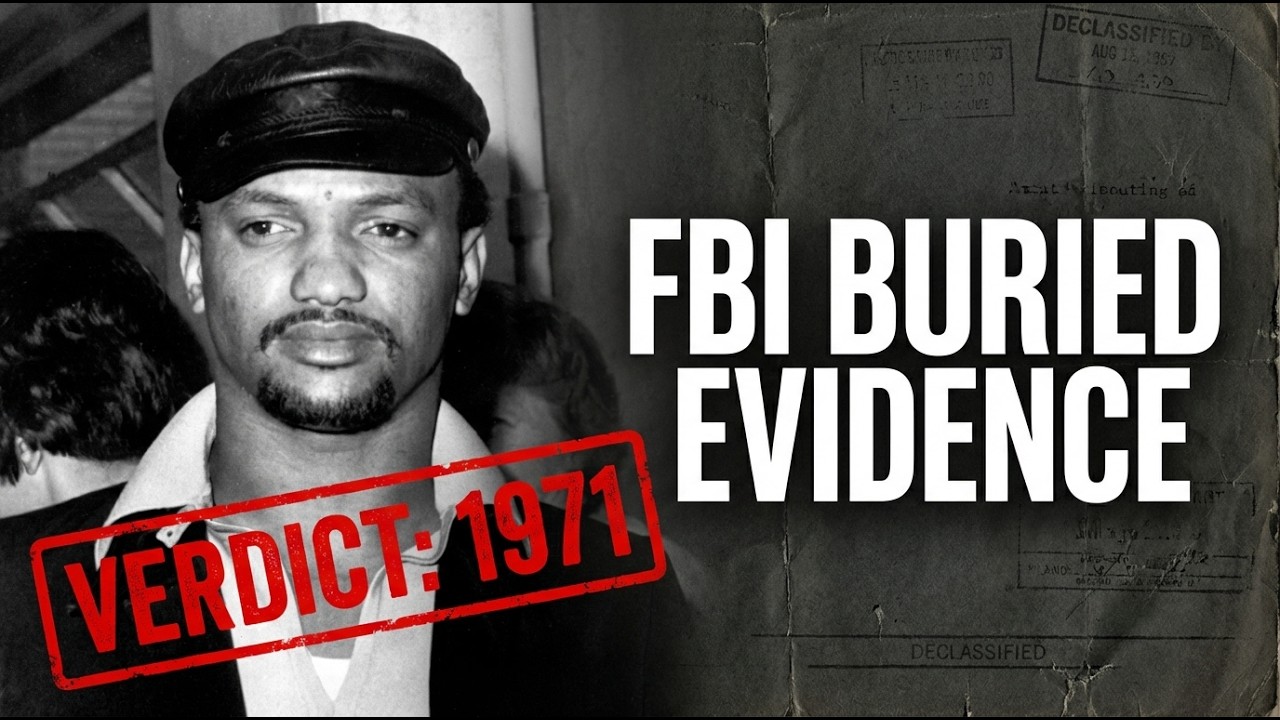
The FBI Hid Wiretap Evidence for 27 Years to Keep Geronimo Pratt in Prison
On December 18, 1968, Caroline Olsen was shot and killed during a robbery on a Santa Monica tennis court. Her husband, Kenneth, survived and initially could not identify the shooter. Two years later, he identified Elmer "Geronimo" Pratt, a decorated Vietnam veteran and the deputy minister of defense for the Los Angeles Black Panther Party.
Pratt maintained he was at a Panther meeting in Oakland, 350 miles north, when the murder occurred. He was convicted in 1972 and sentenced to life in prison. He served twenty-seven years.
What the jury never learned: the FBI had wiretap surveillance confirming Pratt was in Oakland on the night of the murder. The Bureau's electronic surveillance of the Black Panther Party's Los Angeles and Oakland offices was extensive — every phone call monitored, every meeting recorded. The wiretaps placed Pratt in Oakland. The FBI knew he could not have committed the crime. They suppressed the evidence.
The prosecution's key witness was Julius Butler, a former Panther who testified that Pratt had confessed to the killing. What the jury also never learned: Butler was an FBI informant. His handler was FBI Special Agent Richard W. Held, who ran COINTELPRO operations targeting the Los Angeles Panthers. Butler's informant status was known to the prosecution and was not disclosed to the defense.
This was not a Brady violation discovered after the fact. The FBI actively participated in concealing exculpatory evidence during an ongoing murder trial. Internal Bureau memos show that the Los Angeles field office discussed the Pratt case as part of its COINTELPRO strategy to \u201cneutralize\u201d Black Panther leadership. Pratt was identified as a \u201ckey agitator\u201d — the same classification applied to Fred Hampton.
Pratt filed appeals for twenty-seven years. Every appeal was denied. His attorney, Johnnie Cochran, took the case in 1995 and obtained declassified FBI documents through FOIA. The documents revealed Butler's informant status and referenced the wiretap evidence.
On June 10, 1997, Orange County Superior Court Judge Everett Dickey vacated Pratt's conviction. He ruled that the prosecution's failure to disclose Butler's informant status constituted a fundamental violation of due process. The wiretap evidence was cited in the ruling.
Pratt walked out of prison on June 10, 1997 — twenty-seven years after his arrest. He received a $4.5 million settlement from the city of Los Angeles and the federal government. No FBI agent was disciplined. No prosecutor was sanctioned.
Geronimo Pratt had earned two Purple Hearts and a Bronze Star in Vietnam. He returned to the United States and joined the Panthers because, as he said, \u201cthe war was here too.\u201d The FBI's war against him lasted longer than his military service. They had the evidence that would have freed him from the first day of trial. They chose to keep it classified.
Pratt died on June 2, 2011, in Tanzania, where he had relocated after his release. He was sixty-three. The wiretap tapes — the ones that proved his innocence — remain in FBI custody.
The Surveillance State
The FBI’s interest was not coincidental. Under J. Edgar Hoover’s directorship, the Bureau maintained extensive surveillance programs targeting Black leaders, organizations, and cultural figures who challenged the racial status quo. COINTELPRO — the Counter Intelligence Program — was the formal structure, but the surveillance extended well beyond any single program. Field offices across the country maintained files, cultivated informants, and deployed agents to monitor, disrupt, and discredit individuals the Bureau deemed threatening to domestic order.
The methods were systematic: wiretaps, mail interception, infiltration of organizations, anonymous letters designed to destroy relationships and reputations, and coordination with local law enforcement to harass targets through arrests, tax audits, and public smear campaigns. The goal was not simply intelligence gathering — it was neutralization. The Bureau sought to prevent the rise of what internal memos described as a “Black messiah” who could unify and electrify the masses.
Art as Resistance
Music was never just entertainment in this context — it was a weapon, a shield, and a declaration. Black artists who used their platform to address racial injustice understood that their art reached audiences that political speeches could not. A song could cross racial lines, enter homes through radio waves, and plant ideas in minds that might otherwise remain closed. The government understood this too, which is precisely why artists who spoke out became targets.
The relationship between Black music and political power has always been fraught. Record labels, concert promoters, and radio stations — overwhelmingly white-owned — controlled distribution and access. Artists who pushed too far politically risked losing airplay, bookings, and contracts. The choice between commercial success and authentic expression was rarely simple, and those who chose to speak truth through their art often paid a steep professional and personal price.
Justice Deferred
The legal dimensions of this case reveal how the American justice system has historically functioned as both a tool of liberation and a mechanism of oppression. Courts that were capable of landmark civil rights decisions were equally capable of producing outcomes that reinforced racial hierarchies. The same Constitution that guaranteed equal protection under the law was interpreted, for generations, to permit systematic racial discrimination.
What the legal record shows is that justice, when it came at all, came slowly and incompletely. Cases dragged on for years. Evidence was suppressed, witnesses were intimidated, and juries were selected from pools that excluded Black citizens. The system worked exactly as it was designed to work — not to deliver impartial justice, but to maintain the existing social order. When that order was finally challenged, the system resisted with every tool at its disposal.
Why This Matters Now
This history is not merely an account of past events. It is a living document that shapes the present. The institutions that enabled these abuses — the FBI, local police departments, the courts — continue to operate today. The patterns of surveillance, suppression, and selective justice that defined the treatment of Black Americans in the twentieth century did not end with the passage of civil rights legislation. They evolved, adapted, and persisted in forms that are sometimes more subtle but no less consequential.
Understanding this history is essential not as an exercise in guilt or recrimination, but as a foundation for honest engagement with the ongoing challenges of racial justice in America. The stories of individuals who faced overwhelming institutional power and refused to surrender — who insisted on their dignity, their rights, and their humanity in the face of systematic attempts to deny all three — remain relevant because the struggle they waged is not over.
Leave a Reply